

Symbiotic stars are interacting binaries consisting of a cool giant and a hot compact star. Typical orbital periods run between 1-3 years. The giant component losses mass, part of which is accreted by its companion. The hot star ionizes a portion of the giant's wind, giving rise to nebular emission. As a result the spectrum of symbiotic stars consists of basically three components of radiation - two stellar and one nebular. Such composition of the spectrum was demonstrated well for ZAnd, BFCyg and AGDra (Nussbaumer & Vogel 1989; Fernandéz-Castro et al. 1990; Greiner et al. 1997). In many cases the nebular radiation dominates the optical.
A very significant feature of LCs of many symbiotic stars is a
periodic wave-like variation along the orbital motion
(see Fig. 1).
It displays a large amplitude (i.e. magnitude difference between
the maximum and minimum of the light),
 1mag or more,
which is a function of the wavelength - we always observe
1mag or more,
which is a function of the wavelength - we always observe
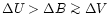 .
The period is approximately equal
to the orbital period, and a minimum occurs at/around the inferior
conjunction of the cool component. These properties relate this type
of variations to the orbital motion. Originally, Boyarchuck (1966)
and Belyakina (1970) suggested a reflection effect as responsible for
such variability in the AGPeg LC. In this model, the hot star irradiates
and heats up the facing giant's hemisphere that causes variation in
the star's brightness when viewing the binary at different orbital phases.
This natural explanation was adopted by many authors (e.g. Kenyon
1986) and it is still popular (e.g. Munari 1989,
1992; Dobrzycka et al. 1993;
Proga et al. 1996, 1998).
On the other hand, some authors have never used the reflection effect
and/or found it to be problematic to interpret their data.
For example, Nussbaumer & Vogel (1987) suggested a new approach
to symbiotic stars based on the interaction of the hot star radiation
with the cool stellar wind.
Formiggini & Leibowitz (1990) found that the reflection effect
requires an extremely high bolometric luminosity of the hot component,
to explain the light variation in AGDra, AXPer and AGPeg.
Schmutz et al. (1994) did not find any
irradiation effect in the red giant spectrum of SYMus, although
its visual LC varies with an amplitude of 0.6mag.
Recently Skopal (1996) demonstrated that the reflection effect
is not a reliable interpretation of the wave-like variation in the optical
continuum of V443Her.
.
The period is approximately equal
to the orbital period, and a minimum occurs at/around the inferior
conjunction of the cool component. These properties relate this type
of variations to the orbital motion. Originally, Boyarchuck (1966)
and Belyakina (1970) suggested a reflection effect as responsible for
such variability in the AGPeg LC. In this model, the hot star irradiates
and heats up the facing giant's hemisphere that causes variation in
the star's brightness when viewing the binary at different orbital phases.
This natural explanation was adopted by many authors (e.g. Kenyon
1986) and it is still popular (e.g. Munari 1989,
1992; Dobrzycka et al. 1993;
Proga et al. 1996, 1998).
On the other hand, some authors have never used the reflection effect
and/or found it to be problematic to interpret their data.
For example, Nussbaumer & Vogel (1987) suggested a new approach
to symbiotic stars based on the interaction of the hot star radiation
with the cool stellar wind.
Formiggini & Leibowitz (1990) found that the reflection effect
requires an extremely high bolometric luminosity of the hot component,
to explain the light variation in AGDra, AXPer and AGPeg.
Schmutz et al. (1994) did not find any
irradiation effect in the red giant spectrum of SYMus, although
its visual LC varies with an amplitude of 0.6mag.
Recently Skopal (1996) demonstrated that the reflection effect
is not a reliable interpretation of the wave-like variation in the optical
continuum of V443Her.
Accordingly we show that the reflection effect cannot explain the orbitally related wave-like modulation of LCs of symbiotic binaries. To demonstrate this, we compare basic observational properties of this variation to those caused by the reflection effect (Sect. 3). In Sect. 4 we describe a simple ionization model, which could be responsible for such variation.
Copyright ESO 2001