 |
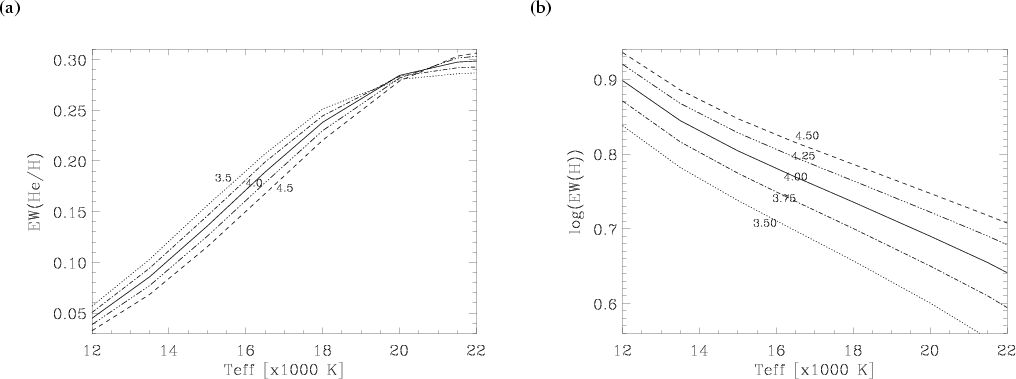
Figure 1:
Diagnostic plots used for the initial estimation of
atmospheric parameters assuming a microturbulence of 5
 :
( left)
the ratio of the equivalent width of the He I line at 4026 Å to
the mean of the hydrogen H :
( left)
the ratio of the equivalent width of the He I line at 4026 Å to
the mean of the hydrogen H  and H
and H  equivalent widths; the
ratio is plotted as a function of effective temperature (
equivalent widths; the
ratio is plotted as a function of effective temperature (
 )
for three
logarithmic surface gravities: ( right) the mean equivalent widths
of the H
and H lines on a logarithmic scale plotted as
a function of effective temperature (
)
for five logarithmic surface
gravities. )
for three
logarithmic surface gravities: ( right) the mean equivalent widths
of the H
and H lines on a logarithmic scale plotted as
a function of effective temperature (
)
for five logarithmic surface
gravities. |
| Open with DEXTER | |
In the text
![\begin{figure}
\par\includegraphics[angle=90,width=6.8cm]{5392f2.ps}
\end{figure}](/articles/aa/full/2006/37/aa5392-06/img25.gif) |
Figure 2: An example of the chi-square minimization procedure used to estimate the projected rotational velocity for the star 4755-030. |
| Open with DEXTER | |
In the text
![\begin{figure}
\par\includegraphics[angle=270,width=6cm]{5392f3a.ps}\par\vspace*{2mm}
\includegraphics[angle=270,width=6cm]{5392f3b.ps}
\end{figure}](/articles/aa/full/2006/37/aa5392-06/img26.gif) |
Figure 3:
Observed and rotationally broadened theoretical
helium line profiles. 4755-033 ( upper panel) and
4755-030 ( lower panel) have estimated values of v sin i of 75 and 330
,
respectively. |
| Open with DEXTER | |
In the text
![\begin{figure}
\par\includegraphics[angle=90,width=7.5cm]{5392f4.ps}\end{figure}](/articles/aa/full/2006/37/aa5392-06/img27.gif) |
Figure 4: Initial estimates of atmospheric parameters for targets in NGC 3293, deduced from the hydrogen and helium equivalent widths. |
| Open with DEXTER | |
In the text
![\begin{figure}
\par\includegraphics[angle=90,width=7.5cm]{5392f5.ps}
\end{figure}](/articles/aa/full/2006/37/aa5392-06/img28.gif) |
Figure 5:
The procedure to correct the atmospheric parameter
estimates for stellar rotation is illustrated for a value of
v sin i of 300 km s-1. Plus sign
(+) mark the atmospheric parameters deduced when the effects of rotation
are included. Diamonds symbols
( )
connected by a line, represent the original
atmospheric parameters, which are designated by the adjacent pairs of numbers
(note
is in )
connected by a line, represent the original
atmospheric parameters, which are designated by the adjacent pairs of numbers
(note
is in  1000 K). The correction factors are given
in parenthesis. 1000 K). The correction factors are given
in parenthesis. |
| Open with DEXTER | |
In the text
![\begin{figure}
\par\includegraphics[width=8.5cm,clip]{5392f6a.eps}\par\vspace*{2...
...s}\par\vspace*{2mm}
\includegraphics[width=8.5cm,clip]{5392f6c.eps}
\end{figure}](/articles/aa/full/2006/37/aa5392-06/img63.gif) |
Figure 6: Hertzsprung-Russell diagrams for the three clusters, together with evolutionary tracks and isochrones taken from the Geneva database. Stars with estimated gravities of less than 3.9 dex are shown as open circles with higher gravity stars represented by closed circles. |
| Open with DEXTER | |
In the text
![\begin{figure}
\par\includegraphics[width=6cm,clip]{5392f7a.eps}\par\vspace*{2mm...
...eps}\par\vspace*{2mm}
\includegraphics[width=6cm,clip]{5392f7c.eps}
\end{figure}](/articles/aa/full/2006/37/aa5392-06/img69.gif) |
Figure 7: Present day mass functions for the three clusters. |
| Open with DEXTER | |
In the text
![\begin{figure}
\par\includegraphics[angle=270,width=6cm,clip]{5392f8a.ps}\par\vs...
...vspace*{2mm}
\includegraphics[angle=270,width=6cm,clip]{5392f8c.ps}
\end{figure}](/articles/aa/full/2006/37/aa5392-06/img84.gif) |
Figure 8: Histograms of projected rotational velocities for each of the three cluster. |
| Open with DEXTER | |
In the text
![\begin{figure}
\par\includegraphics[angle=270,width=15cm]{5392f9.eps}
\end{figure}](/articles/aa/full/2006/37/aa5392-06/img85.gif) |
Figure 9:
Cumulative probability function for all targets in
our two older clusters and in h and  Persei and for those in the
different classes as specified by Strom et al. (2005).
Group 1 - relatively unevolved stars with an effective temperature,
< 17 000; Group 2 - stars with 17 000
Persei and for those in the
different classes as specified by Strom et al. (2005).
Group 1 - relatively unevolved stars with an effective temperature,
< 17 000; Group 2 - stars with 17 000  < 21 000;
Group 3 - stars that have evolved significantly from the main sequence,
< 21 000;
Group 3 - stars that have evolved significantly from the main sequence,
 21 000. The solid lines are for field stars, the dotted lines
are for the h and
Persei sample of Strom et al. (2005)
and the dot-dash lines are our combined sample for the clusters
NGC 3293 and NGC 4755. 21 000. The solid lines are for field stars, the dotted lines
are for the h and
Persei sample of Strom et al. (2005)
and the dot-dash lines are our combined sample for the clusters
NGC 3293 and NGC 4755. |
| Open with DEXTER | |
In the text
![\begin{figure}
\par\includegraphics[width=8.5cm,clip]{5392f10.eps}
\end{figure}](/articles/aa/full/2006/37/aa5392-06/img87.gif) |
Figure 10:
Hertzsprung-Russell diagrams for the h and
Persei cluster,
together with evolutionary tracks and isochrones taken from the Geneva
database. |
| Open with DEXTER | |
In the text
![\begin{figure}
\par\includegraphics[angle=270,width=6.5cm,clip]{5392f11a.eps}\pa...
...ce*{2mm}
\includegraphics[angle=270,width=6.5cm,clip]{5392f11b.eps}
\end{figure}](/articles/aa/full/2006/37/aa5392-06/img93.gif) |
Figure 11:
The histogram of the observed projected rotational
velocities for targets in the clusters NGC 3293 and NGC 4755
is compared with models assuming an intrinsic rotational velocity
distribution of a delta-function a) and a uniform distribution b). The histogram data includes only stars in the mass range 3-15  i.e. the evolved objects have been removed. In panel a) all stars
have been assumed to rotate at
velocities of 350
(solid curve) and 250
(dashed curve).
In panel b) continuous distributions of velocities between zero
and a maximum of 350
(solid curve) and 250
(dashed curve) are assumed. It is clear
that neither
rotational velocity distribution provides convincing
agreement with the observed velocity histograms.
i.e. the evolved objects have been removed. In panel a) all stars
have been assumed to rotate at
velocities of 350
(solid curve) and 250
(dashed curve).
In panel b) continuous distributions of velocities between zero
and a maximum of 350
(solid curve) and 250
(dashed curve) are assumed. It is clear
that neither
rotational velocity distribution provides convincing
agreement with the observed velocity histograms. |
| Open with DEXTER | |
In the text
![\begin{figure}
\par\includegraphics[width=7cm,clip]{5392f12a.eps}\par\vspace*{2mm}
\includegraphics[width=7cm,clip]{5392f12b.eps}
\end{figure}](/articles/aa/full/2006/37/aa5392-06/img95.gif) |
Figure 12:
Upper panel:
the histogram of observed projected rotational velocities for targets
in the clusters NGC 3293 and NGC 4755 is compared with the model assuming
a Gaussian distribution of rotational velocities. The Gaussian has a maximum
at a rotational velocity 250
and a
 .
The histogram data includes only stars
in the mass range 3-15
i.e. the evolved objects
have been removed. Lower Panel: the NGC 6611 stars, with a Gaussian
distribution with a
maximum at 175
and a
.
The histogram data includes only stars
in the mass range 3-15
i.e. the evolved objects
have been removed. Lower Panel: the NGC 6611 stars, with a Gaussian
distribution with a
maximum at 175
and a
 .
. |
| Open with DEXTER | |
In the text
![\begin{figure}
\par\includegraphics[width=7.8cm,clip]{5392f13a.eps}\par\vspace*{...
...}\par\vspace*{2mm}
\includegraphics[width=7.8cm,clip]{5392f13c.eps}
\end{figure}](/articles/aa/full/2006/37/aa5392-06/img96.gif) |
Figure 13:
Hertzsprung-Russell diagrams for the three clusters together with
rotating stellar evolutionary models from the Geneva group. The symbols are
as in Fig. 6, and all the models have an initial equatorial
rotational velocity of 300
.
The tracks for the 25-60
models have
been truncated before the bluewards evolution towards the WR phase, to aid
clarity. |
| Open with DEXTER | |
In the text
![\begin{figure}
\par\includegraphics[width=16.8cm,clip]{5392fc6.eps}
\end{figure}](/articles/aa/full/2006/37/aa5392-06/img97.gif) |
Figure A.1: VLT-FLAMES targets (open circles) and FEROS targets (open squares) in the NGC 6611 field. |
In the text
![\begin{figure}
\par\includegraphics[width=15cm,clip]{5392fc3c.eps}
\end{figure}](/articles/aa/full/2006/37/aa5392-06/img98.gif) |
Figure A.2: VLT-FLAMES targets (open circles) and FEROS targets (open squares) in the inner 7' of the NGC 3293 field. |
In the text
![\begin{figure}
\par\includegraphics[width=16.8cm,clip]{5392fc3.eps}
\end{figure}](/articles/aa/full/2006/37/aa5392-06/img99.gif) |
Figure A.3: VLT-FLAMES targets (open circles) and FEROS targets (open squares) in the NGC 3293 field. Most of the objects observed in the inner region are shown separately in Fig. A.2. |
In the text
![\begin{figure}
\par\includegraphics[width=15cm,clip]{5392fc4c.eps}
\end{figure}](/articles/aa/full/2006/37/aa5392-06/img100.gif) |
Figure A.4: VLT-FLAMES targets (open circles) and FEROS targets (open squares) in the inner 7' of the NGC 4755 field. |
In the text
![\begin{figure}
\par\includegraphics[width=16.8cm,clip]{5392fc4.eps}\end{figure}](/articles/aa/full/2006/37/aa5392-06/img101.gif) |
Figure A.5: VLT-FLAMES targets (open circles) and FEROS targets (open squares) in the NGC 4755 field. Most of the objects observed in the inner region are shown separately in Fig. A.4. |
In the text