


Fig.11
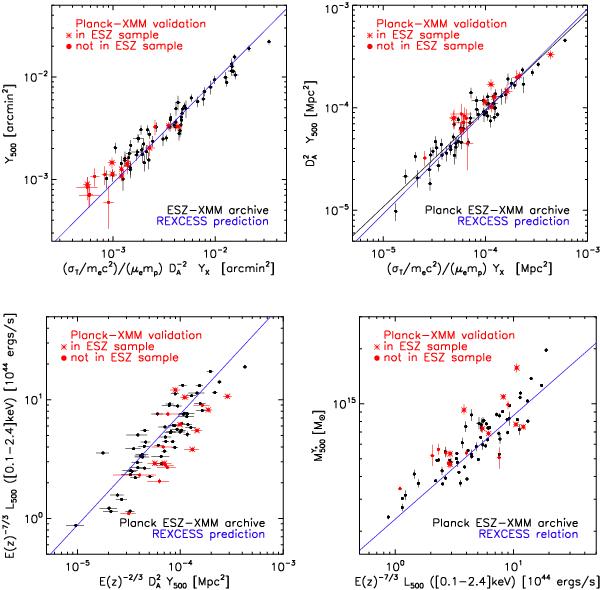
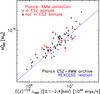
Scaling relations for the 17 new confirmed single-component clusters (red symbols).
Black points show clusters in the Planck-ESZ sample with
XMM-Newton archival data as presented in Planck Collaboration (2011g). The solid black line denotes the
corresponding scaling relation fits in each panel. The blue lines in the top
and bottom right panels denote the predicted
Y500 scaling relations from the REXCESS X-ray
observations (Arnaud et al. 2010). The blue
line in the bottom left panel is the Malmquist bias corrected
M–L relation from the REXCESS sample (Pratt et al. 2009; Arnaud et al. 2010). In all figures,
R500 and M500 are
estimated from the M500–YX
relation of Arnaud et al. (2010). Top
row: relation between apparent SZ signal
(Y500, left) or intrinsic Compton
parameter ( ,
right) and the corresponding normalised
YX parameter. Bottom row: relation
between X-ray luminosity and Y500
(left) and between mass and luminosity (right
panel). The new clusters are on average less luminous at a given
Y500, or more massive at a given luminosity, than
X-ray selected clusters.
,
right) and the corresponding normalised
YX parameter. Bottom row: relation
between X-ray luminosity and Y500
(left) and between mass and luminosity (right
panel). The new clusters are on average less luminous at a given
Y500, or more massive at a given luminosity, than
X-ray selected clusters.
Current usage metrics show cumulative count of Article Views (full-text article views including HTML views, PDF and ePub downloads, according to the available data) and Abstracts Views on Vision4Press platform.
Data correspond to usage on the plateform after 2015. The current usage metrics is available 48-96 hours after online publication and is updated daily on week days.
Initial download of the metrics may take a while.