


Fig. 11
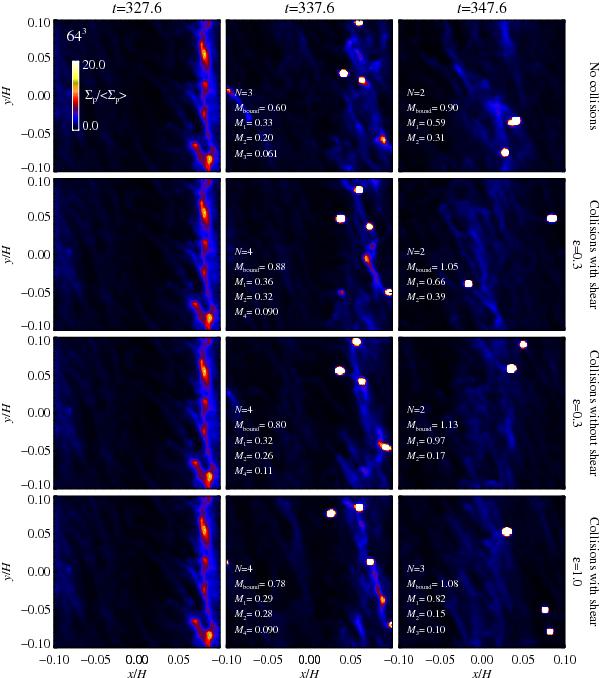
Particle column density versus time after self-gravity is turned on at t0 = 52Torb = 326.726Ω-1 in the simulation SI64_e0.3_NS. An overdense sheet forms by the streaming instability and breaks up in a number of gravitationally bound clumps. We indicate the number of clumps and their masses, in units of the mass of the dwarf planet Ceres, in the lower left part of the plots. Between 3 and 4 clumps condense out independently of how collisions are treated, with masses slightly smaller than Ceres. Clump merging, likely driven by the artificially large sizes of the planetesimals, reduces the number of clumps with time in all cases. Note that the initial condition for all four simulations is taken from SI64_e0.3_NS.
Current usage metrics show cumulative count of Article Views (full-text article views including HTML views, PDF and ePub downloads, according to the available data) and Abstracts Views on Vision4Press platform.
Data correspond to usage on the plateform after 2015. The current usage metrics is available 48-96 hours after online publication and is updated daily on week days.
Initial download of the metrics may take a while.