


Fig. 2
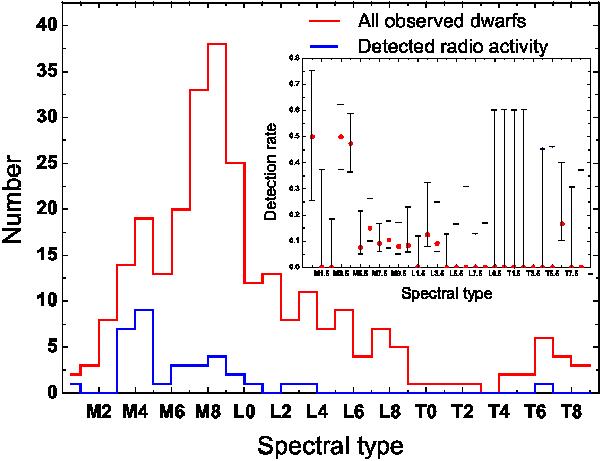
Number distribution of observed dwarfs (red line) and dwarfs with detected radio signal (blue line) with respect to their spectral type. The insert panel shows the detection rate as a function of spectral type, defined by Nr/N, where Nr is the number of dwarfs with detected radio signal in a certain spectral type range; N is the number of observed dwarfs in the same spectral type range. In the spectral type range of M0-T8, the total number of observed dwarfs is 273, while the number of dwarfs with detected radio signal is 34. The zero detection rate around spectral type M2 is most likely due to the limited number of observations. Also shown are the uncertainties of the detection rates, estimated by adopting the binomial distribution at 1σ level for the Gaussian distribution (see Sect. 3).
Current usage metrics show cumulative count of Article Views (full-text article views including HTML views, PDF and ePub downloads, according to the available data) and Abstracts Views on Vision4Press platform.
Data correspond to usage on the plateform after 2015. The current usage metrics is available 48-96 hours after online publication and is updated daily on week days.
Initial download of the metrics may take a while.