


Fig. 10
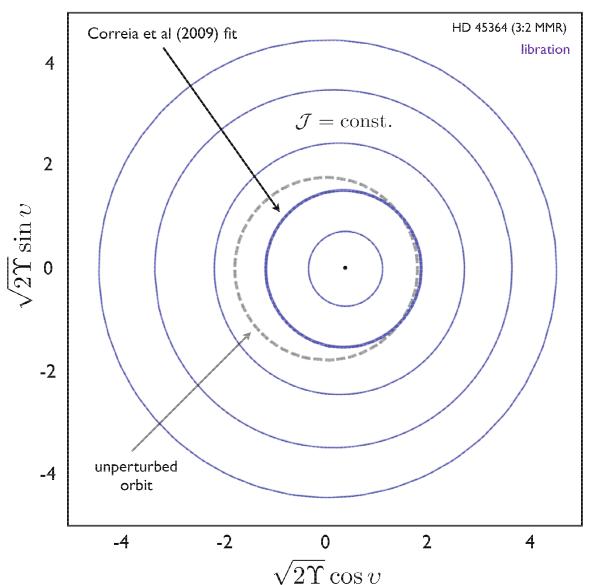
Poincare surface of section corresponding to the energy and angular momentum levels of Correia et al. (2009). Various starting values of Υ are considered and the solutions arising from the Hamiltonian (48) are plotted as solid lines. The thick curve corresponds to the evolution originating from the actual (Correia et al. 2009) orbital fit. For reference, the trivial (Υ,υ) evolution of the (Correia et al. 2009) fit within the context of the integrable Hamiltonian (29) is also shown as dashed curve. The considered system resides sufficiently deeply within the resonance that the trajectories never overlap with neighboring first-order resonances. Furthermore, as can be gleamed from the figure, the secular modulation of the system is weak. That is, the value of Υ never undergoes large variations. Consequently, the critical curve in the (Ξ,ξ) plane is never encountered and the pseudo-integral  is conserved along the trajectories. The dynamical portrait of the considered configuration is completely regular, (within the context of the second-order expansion of the disturbing function).
Current usage metrics show cumulative count of Article Views (full-text article views including HTML views, PDF and ePub downloads, according to the available data) and Abstracts Views on Vision4Press platform.
Data correspond to usage on the plateform after 2015. The current usage metrics is available 48-96 hours after online publication and is updated daily on week days.
Initial download of the metrics may take a while.