


Fig. 7
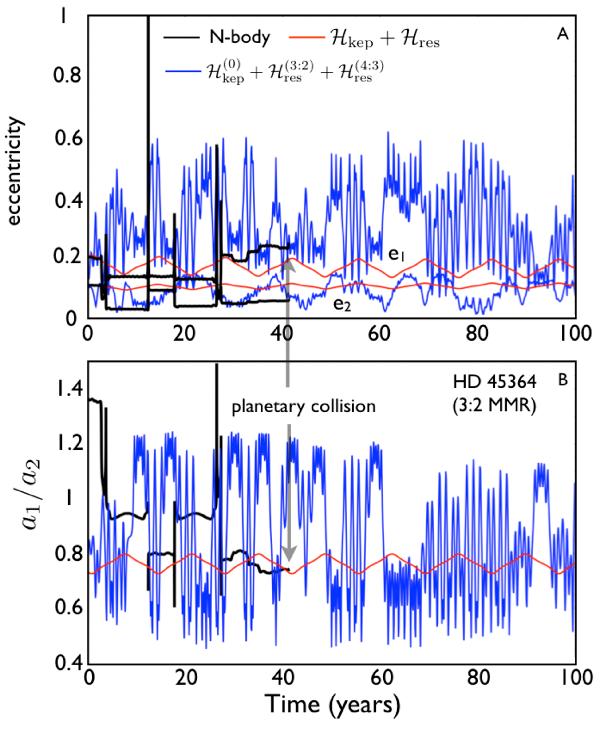
Chaotic evolution of a 3:2 resonant system at differing levels of approximation. Panels A) and B) show the orbital eccentricities and the semi-major axis ratio respectively. The initial conditions of the described system correspond to the same level of Ψ2, as that of the Correia et al. (2009) fit. However, the energy level is chosen such that the motion overlaps the 4:3 resonance. Specifically, the second outermost energy level, plotted in Fig. 5 is considered. As in Fig. 6, the black curve corresponds to the result of a numerical N-body integration. Within the context of the N-body solution, the planets reverse order shortly after the beginning of the integration and subsequently suffer a mutual collision after ~40 years of dynamical evolution. The blue curve represents the results obtained by numerical integration of the perturbative Hamiltonian (32), that contains both resonant arguments. The inadequacy of the integrable approximation (29) (plotted in red) in a chaotic domain can easily be seen.
Current usage metrics show cumulative count of Article Views (full-text article views including HTML views, PDF and ePub downloads, according to the available data) and Abstracts Views on Vision4Press platform.
Data correspond to usage on the plateform after 2015. The current usage metrics is available 48-96 hours after online publication and is updated daily on week days.
Initial download of the metrics may take a while.