


Fig. 2
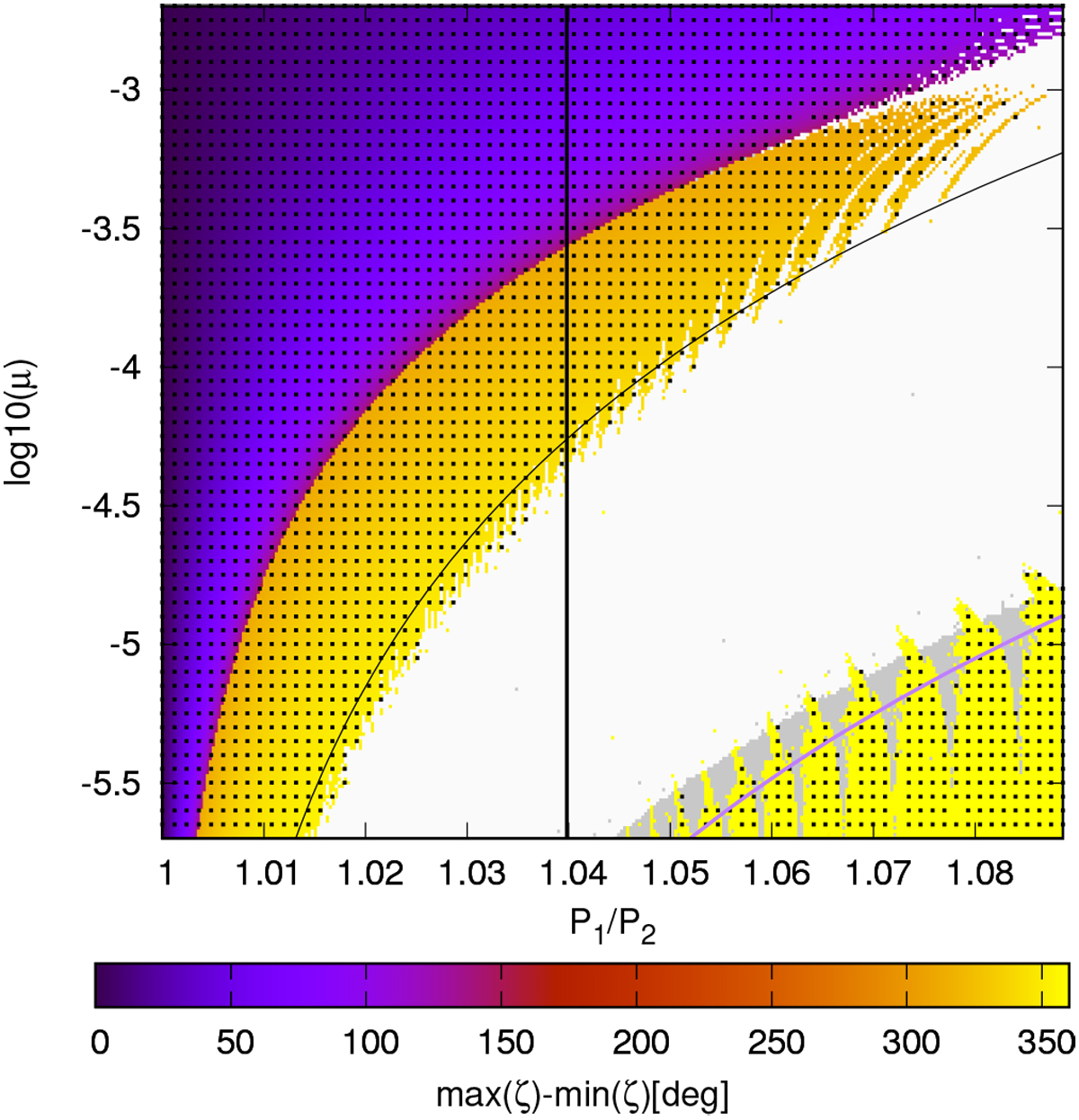
Stability map as a function of P1∕P2 and μ = (m1 + m2)∕m0, for circular coplanar orbits, taking ζ = 60° as initial condition (vertical dashed line in Fig. 1). Coloured pixels are long-term stable with respect to the integration time of 105 orbits. Grey pixels are long-term unstable, and white pixels are short-term unstable. The black curve represents the mutual Hill radius of the planets,  , while the vertical line represents P1∕P2 ≈ 1.04 which is close to the estimated value for the candidates of the TOI-178 system discussed in Sect. 3. The colour code is the amplitude of libration: black for zero (lagrangian equilibria), orange for horseshoe orbits. The bottom-right corner shows stable orbits outside of the co-orbital area, in yellow. The purple line is the stability criterion from the overlapping of first-order MMRs (Deck et al. 2013). Black dots represent orbits that are stable over 1010 orbital periods; see the text for more details.
Current usage metrics show cumulative count of Article Views (full-text article views including HTML views, PDF and ePub downloads, according to the available data) and Abstracts Views on Vision4Press platform.
Data correspond to usage on the plateform after 2015. The current usage metrics is available 48-96 hours after online publication and is updated daily on week days.
Initial download of the metrics may take a while.