


Fig. 1.
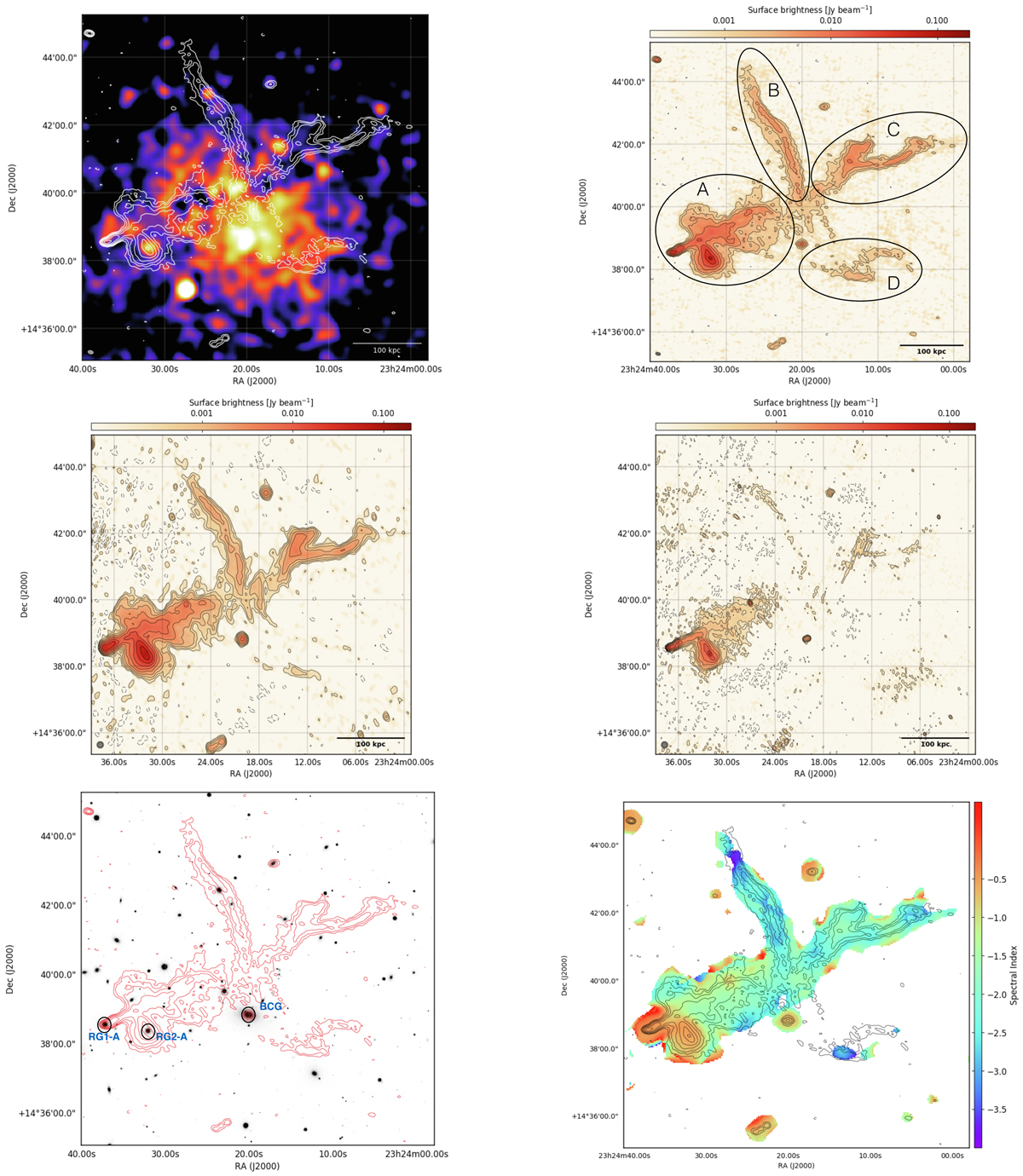
Top left panel: full-resolution LOFAR image contours (white; as shown in the right panel) of Abell 2593, overlaid on an exposure-corrected Chandra image in the 0.5−2.0 keV energy band with a total integration time of 7 ks. Top right panel: 150 MHz LOFAR image (9″ × 6″). The black contours and dashed lines show the (1,2,4,...) × 5 × σLOFAR150 and −3 × σLOFAR150 levels, respectively, where σLOFAR150 = 219 μJy beam−1. Middle left panel: 325 MHz GMRT image (11″ × 7″). The black contours and dashed lines show the (1,2,4,...) × 5 × σGMRT325 and −3 × σGMRT325 levels, respectively, where σGMRT325 = 66 μJy beam−1. Middle right panel: 610 MHz GMRT image (5″ × 4″). The black contours and dashed lines show the (1,2,4,...) × 5 × σGMRT610 and −3 × σGMRT610 levels, respectively, where σGMRT610 = 38 μJy beam−1. Bottom left panel: LOFAR 150 MHz contours (shown in the top left panel) in red overlaid on an SDSS r-band image of Abell 2593. The labelled galaxies (RG1-A and RG2-A) are the possible counterparts for the radio emission of regions A and C. The BCG label indicates the brightest cluster galaxy. Bottom right panel: LOFAR 150 MHz contours (shown in the top right panel) overplotted on the high-resolution (20″ × 20″) spectral index map of Abell 2593.
Current usage metrics show cumulative count of Article Views (full-text article views including HTML views, PDF and ePub downloads, according to the available data) and Abstracts Views on Vision4Press platform.
Data correspond to usage on the plateform after 2015. The current usage metrics is available 48-96 hours after online publication and is updated daily on week days.
Initial download of the metrics may take a while.