


Fig. 18
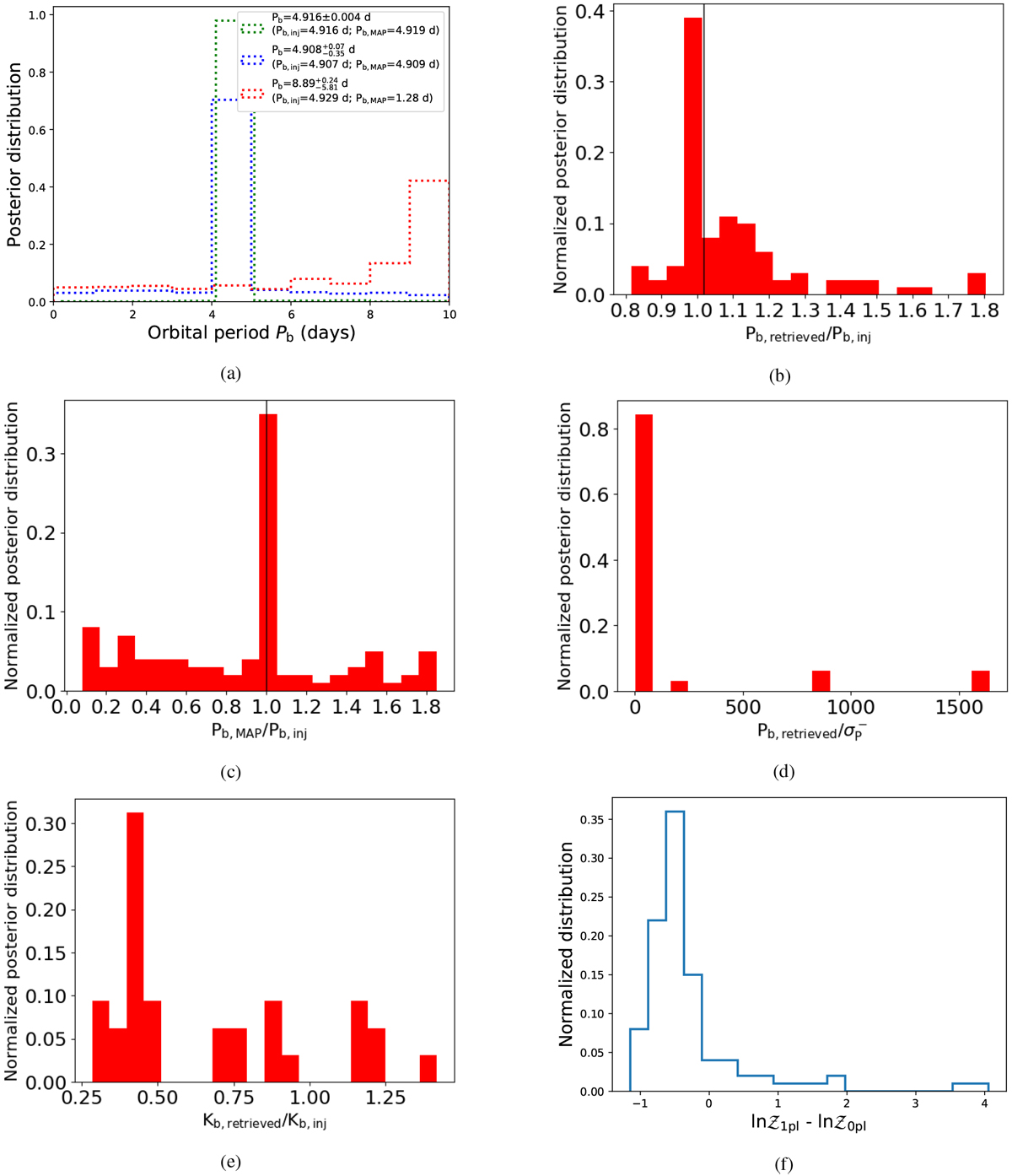
Panel a: posterior distributions of the orbital period Pb of the injected planet for some selected mock datasets. The histogram in green corresponds to a dataset for which Pb has been recovered with high precision and accuracy. The posterior in blue corresponds to a case with a very accurate but less precise retrieved Pb, and the posterior in red corresponds to a mock dataset for which the orbital period was not recovered. Panel b: distribution of the Pb, retrieved/Pb, inj ratio between the median best-fit orbital period and the injected value for each simulated dataset. Panel c: same as for panel b, but using the values of Pb corresponding to the MAP estimates. Panel d: distribution of the significance of the retrieved best-fit values Pb for the S32 sub-sample described in the text. The significance is expressed as the ratio between the median of the posterior and the corresponding lower uncertainty for each simulated dataset. Panel e: distribution of the ratio between the recovered and injected semi-amplitude Kb of the planetary RV signal for the 32% of the simulated datasets for which an accurate and precise estimate of Pb was recovered (S32 sample). Panel f: results of a model comparison analysis. The plot shows the distribution of the difference
 -
- , calculated for the 100 mock RV datasets, between the Bayesian evidence of the model including one sinusoid (i.e. one planet on a circular orbit) and the model with only a GP-term. The model including one planet is marginally more significant (
 -
- 2) only in two cases, one being that corresponding to the posterior of Pb
in green shown in panel a.
2) only in two cases, one being that corresponding to the posterior of Pb
in green shown in panel a.
Current usage metrics show cumulative count of Article Views (full-text article views including HTML views, PDF and ePub downloads, according to the available data) and Abstracts Views on Vision4Press platform.
Data correspond to usage on the plateform after 2015. The current usage metrics is available 48-96 hours after online publication and is updated daily on week days.
Initial download of the metrics may take a while.