


Fig. 2
Download original image
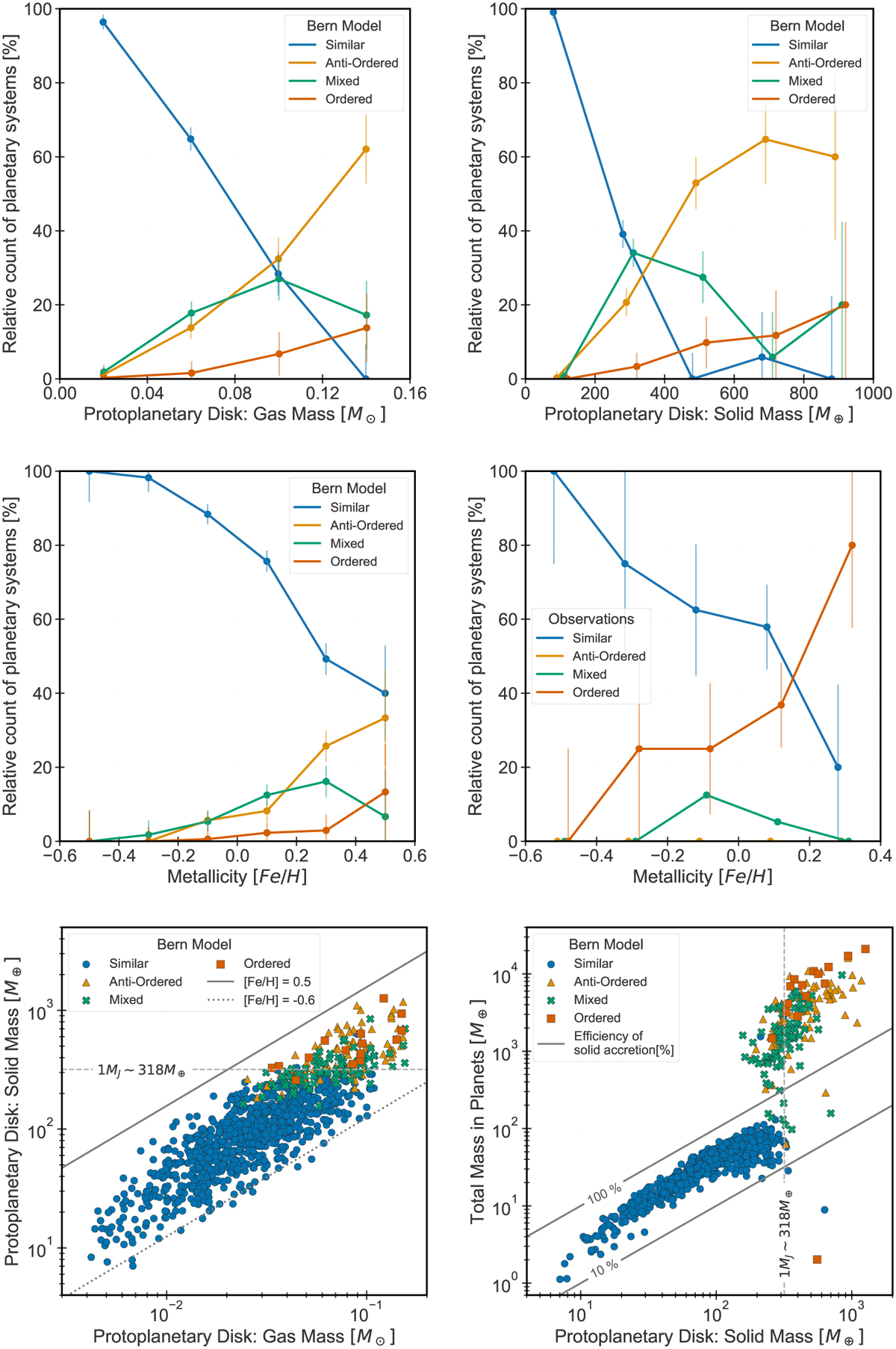
Role of disk mass and the metallicity–architecture correlation. The top two rows show the binned relative count of each architecture class as a function of initial disk gas mass (upper left), disk solid mass (upper right), stellar metallicity in the synthetic population (middle left), and stellar metallicity in observed systems (middle right). The length of the error bars corresponds to the total number of systems in each bin as:  . In the bottom panels, each point corresponds to a single planetary system. The system architecture is indicated by the colour and shape of the marker. The bottom left panel shows the solid mass in the disk as a function of the disk gas mass. The two diagonal lines convey the role of stellar metallicity. The dashed horizontal line indicates the mass of Jupiter. The bottom right panel shows the total mass in planets as a function of the solid mass in the protoplanetary disk. The two diagonal lines indicate the efficiency of converting solids from the disk into planets. If the planets in a hypothetical system could accrete all the solid mass of its disk, and these planets had no gaseous atmosphere, then such a system would lie on the diagonal line corresponding to 100% accretion efficiency. The dashed vertical line indicates the mass of Jupiter.
Current usage metrics show cumulative count of Article Views (full-text article views including HTML views, PDF and ePub downloads, according to the available data) and Abstracts Views on Vision4Press platform.
Data correspond to usage on the plateform after 2015. The current usage metrics is available 48-96 hours after online publication and is updated daily on week days.
Initial download of the metrics may take a while.