


Fig. 9
Download original image
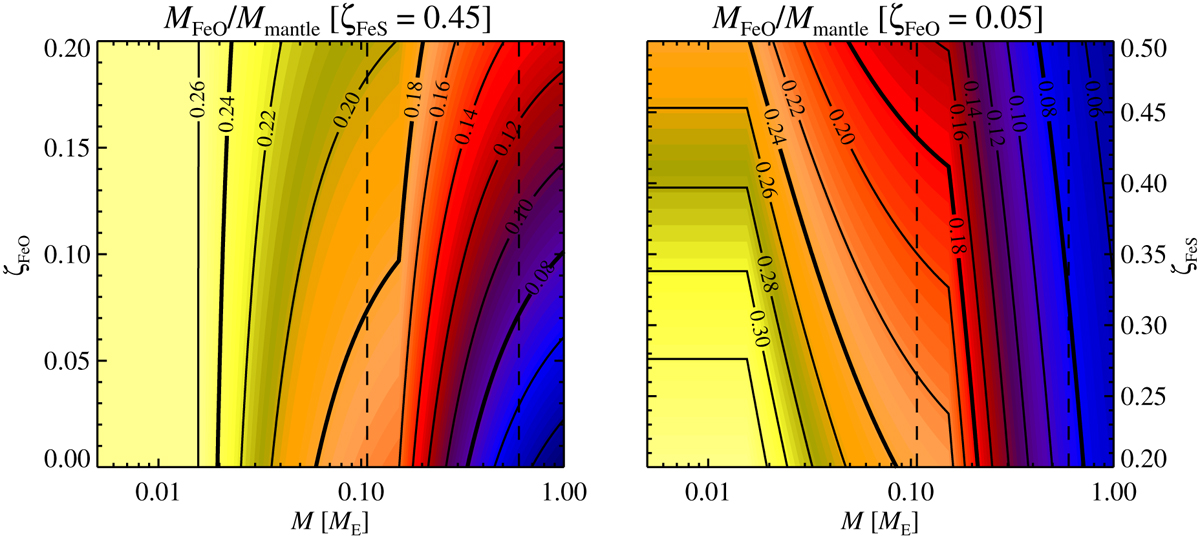
Results of a simple model for calculating the final FeO fraction of planetary bodies as a function of the final mass. We maintain a constant ζFeS = 0.45 in the leftxpl panel and vary the FeO fraction ζFeO of the accreted pebbles, while in the right panel we fix ζFeO = 0.05 and vary ζFeS.The FeO mantle fractions of Vesta (24%), Mars (18%) and Earth (8%) are indicated with thick contours and the planetary masses of Mars and proto-Earth (before the moon-forming planetary collision) are indicated with dashed lines. The FeO fraction of Earth is very sensitive to the FeO fraction of the accreted pebbles, with best fits obtained around ζFeO = 0.05. Mars, on the other hand, obtains most of its FeO from oxidizing its metallic Fe and accreting FeO-rich planetesimals and its mantle FeO contents are relatively independent of the oxidation degree of the pebbles. The FeO fraction of Vesta’s mantle depends mainly on the FeS fraction of the pebbles. The right plot shows that low values of ζFeS lead to very high mantle FeO fractions for low-mass planets and planetesimals. The FeO mantle fractions of Mars and Earth are relatively independent of the FeS fraction, although values below ζFeS = 0.3 yield too low core masses and too high FeO mantle fractions.
Current usage metrics show cumulative count of Article Views (full-text article views including HTML views, PDF and ePub downloads, according to the available data) and Abstracts Views on Vision4Press platform.
Data correspond to usage on the plateform after 2015. The current usage metrics is available 48-96 hours after online publication and is updated daily on week days.
Initial download of the metrics may take a while.