


Fig. 5.
Download original image
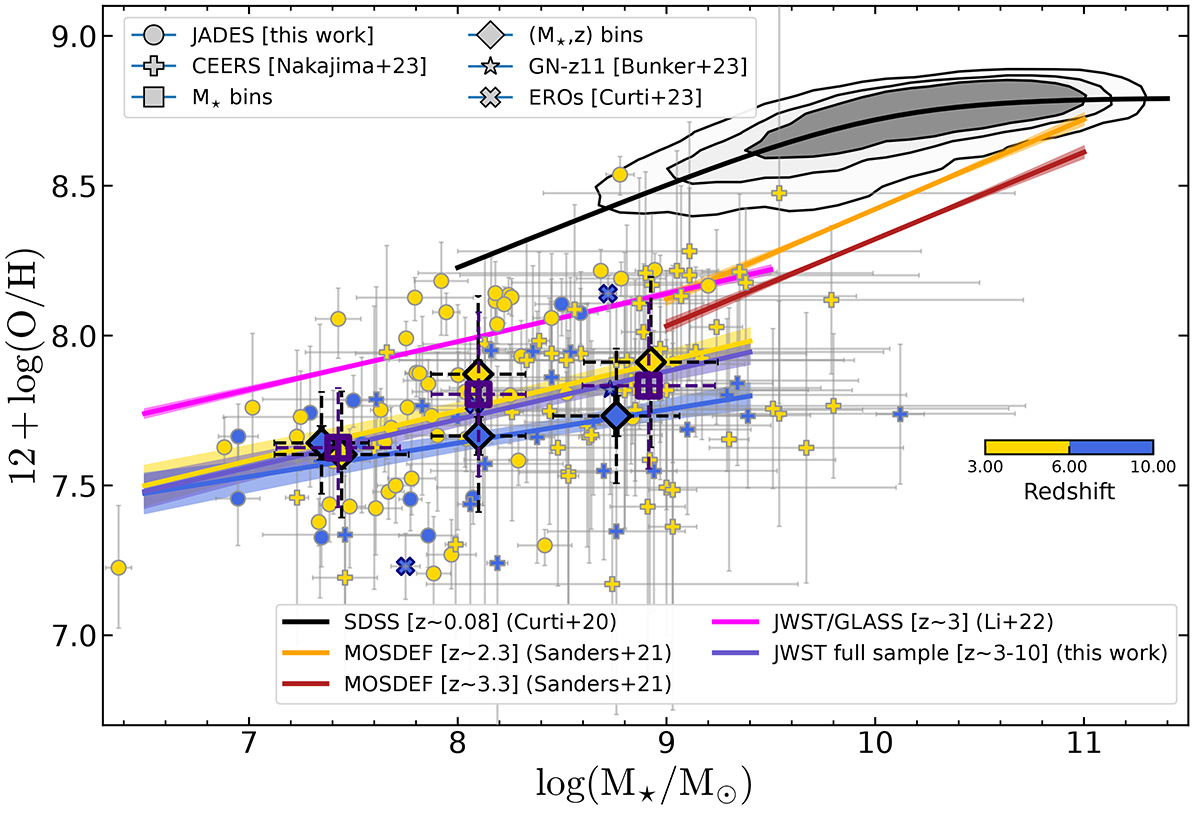
Mass-metallicity relation (MZR) for our full JWST sample. Filled circles represent individual galaxies presented in this work from JADES, whereas filled crosses are galaxies observed in the framework of the CEERS programme and compiled from Nakajima et al. (2023), with metallicity derived as detailed in Sect. 3.1. The star symbol reports the JADES/NIRSpec observations of GN-z11 (Bunker et al. 2023b, at z = 10.603), whereas ‘X’ symbols mark galaxies from the EROs as compiled from Curti et al. (2023) and Laseter et al. (2024). Large squared and diamond symbols mark the median values computed in bins of M⋆ (full sample, in purple), and (M⋆ z), as described in Table 2. An orthogonal linear regression fit to the median values in bins of M⋆ for the different redshift sub-samples is shown by the purple (full sample), yellow (z = 3 − 6) and blue (z = 6 − 10) lines, respectively. We include a comparison with previous determinations of the MZR at lower redshifts from Curti et al. (2020b; SDSS at z ∼ 0.07), and Sanders et al. (2021; MOSDEF at z ∼ 2 − 3), as well as the best-fit of the low-mass end of the MZR at z ∼ 3 provided by Li et al. (2023) and based on JWST/NIRISS slitless spectroscopy. The MZR curves at z ∼ 2 − 3 have been scaled down by ∼0.1 dex to account for the systematics differences between the metallicity calibrations used in this work and the Bian et al. (2018) calibrations adopted in the original papers.
Current usage metrics show cumulative count of Article Views (full-text article views including HTML views, PDF and ePub downloads, according to the available data) and Abstracts Views on Vision4Press platform.
Data correspond to usage on the plateform after 2015. The current usage metrics is available 48-96 hours after online publication and is updated daily on week days.
Initial download of the metrics may take a while.