


Fig. 6.
Download original image
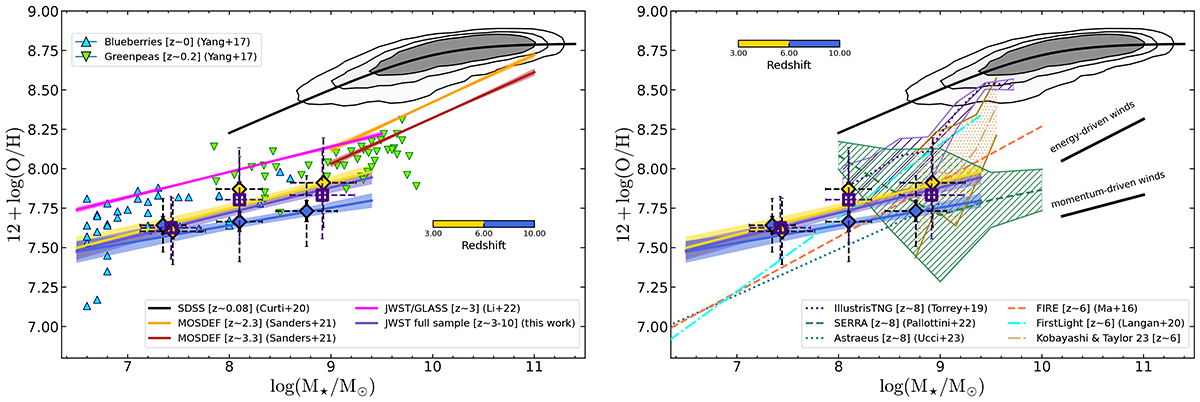
Comparison with local analogues and cosmological simulations. Left-hand panel: the best-fit MZR presented in this work (for both the full JWST sample in purple, and in the z = 3 − 6 and z = 6 − 10 redshift binsin yellow and blue, respectively) is compared to the Te-based mass-metallicity relation from local, metal-poor ‘Blueberry’ and ‘Green Pea’ galaxies (Yang et al. 2017a,b), which share similar excitation and emission line properties to our high-redshift galaxy sample (Cameron et al. 2023b). Their distribution agrees well in slope and normalisation (with ∼0.11 dex offset in log(O/H)) with the average relation inferred in this work for our low-mass JWST sample. Right-hand panel: our best-fit MZRs are compared with the predictions from different suites of cosmological simulations at z ∼ 6–8, namely FIRE (Ma et al. 2016), IllustrisTNG (Torrey et al. 2019), FirstLight (Langan et al. 2020), Astraeus (Ucci et al. 2023), SERRA (Pallottini et al. 2022), and with the chemodynamical simulations from Kobayashi & Taylor (2023). In addition, the typical MZR slopes predicted by (semi-) analytical chemical evolution models (e.g. Davé et al. 2012) implementing feedback via either ‘energy-driven’ or ‘momentum-driven’ winds are also shown (the normalisation is assumed arbitrary to aid visualisation). The latter agrees well with the slope observed at low stellar mass for galaxies at z ≥ 3.
Current usage metrics show cumulative count of Article Views (full-text article views including HTML views, PDF and ePub downloads, according to the available data) and Abstracts Views on Vision4Press platform.
Data correspond to usage on the plateform after 2015. The current usage metrics is available 48-96 hours after online publication and is updated daily on week days.
Initial download of the metrics may take a while.