


Fig. 4
Download original image
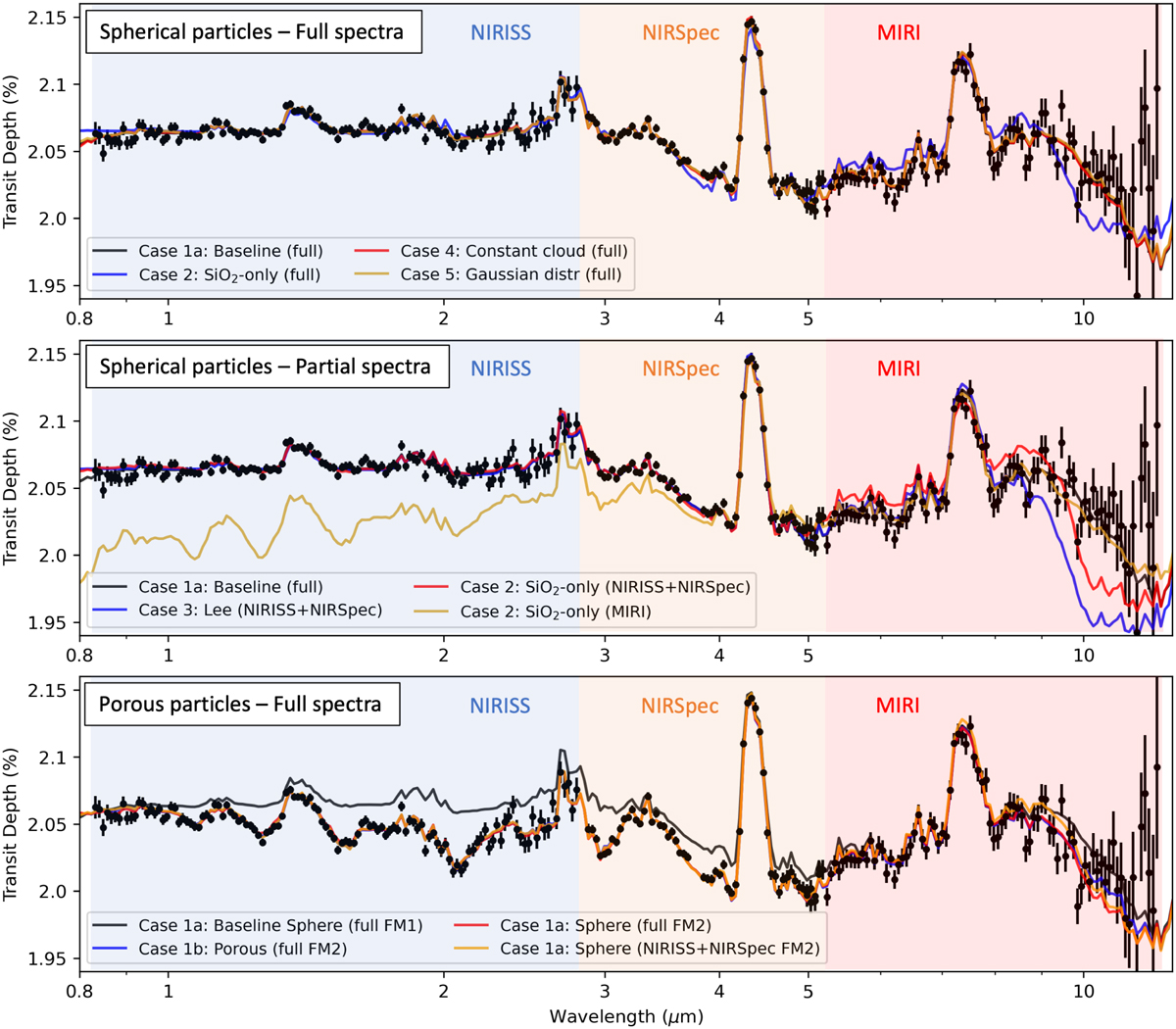
Simulated observations and retrieval best-fit models of our controlled experiments. The top panel shows retrievals on the full simulated spectrum with JWST/NIRISS, JWST/NIRSpec-G395H, and JWST/MIRI. The middle panel shows retrievals on subsets of the simulated data. Both panels use the FM1, where aerosol particles are spherical. The bottom panel shows retrievals on the FM2, where aerosol particles are 50% porous. This ensemble of simulations (and corresponding posterior distributions in Figures D.1 and D.2) illustrates the need for a wide wavelength coverage to constrain aerosol properties accurately. Retrievals restricted to a narrow wavelength coverage (NIRISS+NIRSpec) or (MIRI) are at risk of biases, especially when using incorrect refractive indexes (properties that are a priori poorly known). Porosity is difficult to infer from JWST data (even when using the full dataset), as it is degenerate with other parameters (i.e., models using spherical particles can achieve good fits).
Current usage metrics show cumulative count of Article Views (full-text article views including HTML views, PDF and ePub downloads, according to the available data) and Abstracts Views on Vision4Press platform.
Data correspond to usage on the plateform after 2015. The current usage metrics is available 48-96 hours after online publication and is updated daily on week days.
Initial download of the metrics may take a while.