


Fig. 4.
Download original image
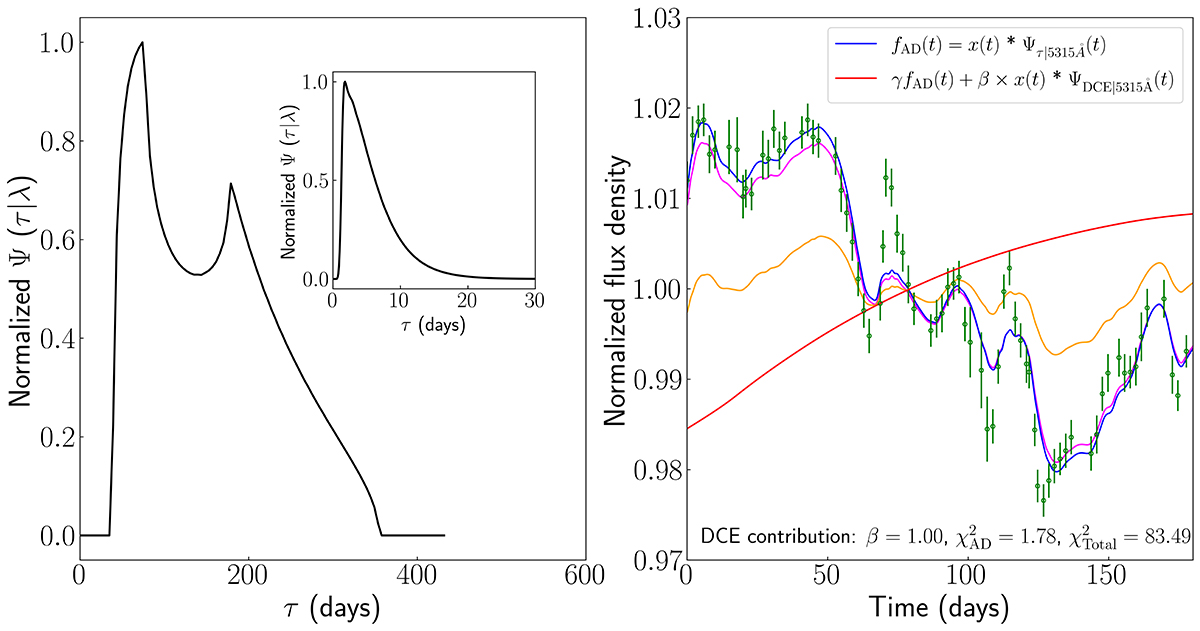
Left: DCE transfer function, centred at 162 light days based on the mean emissivity radius of the CIV BLR, is significantly broader than the accretion disc transfer function at 5315 Å shown in the inset. Its pronounced double-peaked structure is expected from a disc-like BLR geometry (i = 40°), resulting in longer and more complex light-travel delays than in the compact inner accretion disc region. Right: Observed light curve at 5315 Å (green points) compared to various models. The pure accretion disc model (i = 0°; blue) reproduces variability consistent with the expected broadening from the disc transfer function alone. Introducing a moderate 3.9% DCE contribution (magenta) slightly smooths the variability amplitude. Increasing the DCE fraction to 50% (orange) or 100% (red) overly smooths the light curve, failing to replicate its sharp variability features; see Appendix C for details.
Current usage metrics show cumulative count of Article Views (full-text article views including HTML views, PDF and ePub downloads, according to the available data) and Abstracts Views on Vision4Press platform.
Data correspond to usage on the plateform after 2015. The current usage metrics is available 48-96 hours after online publication and is updated daily on week days.
Initial download of the metrics may take a while.