


Fig. 5.
Download original image
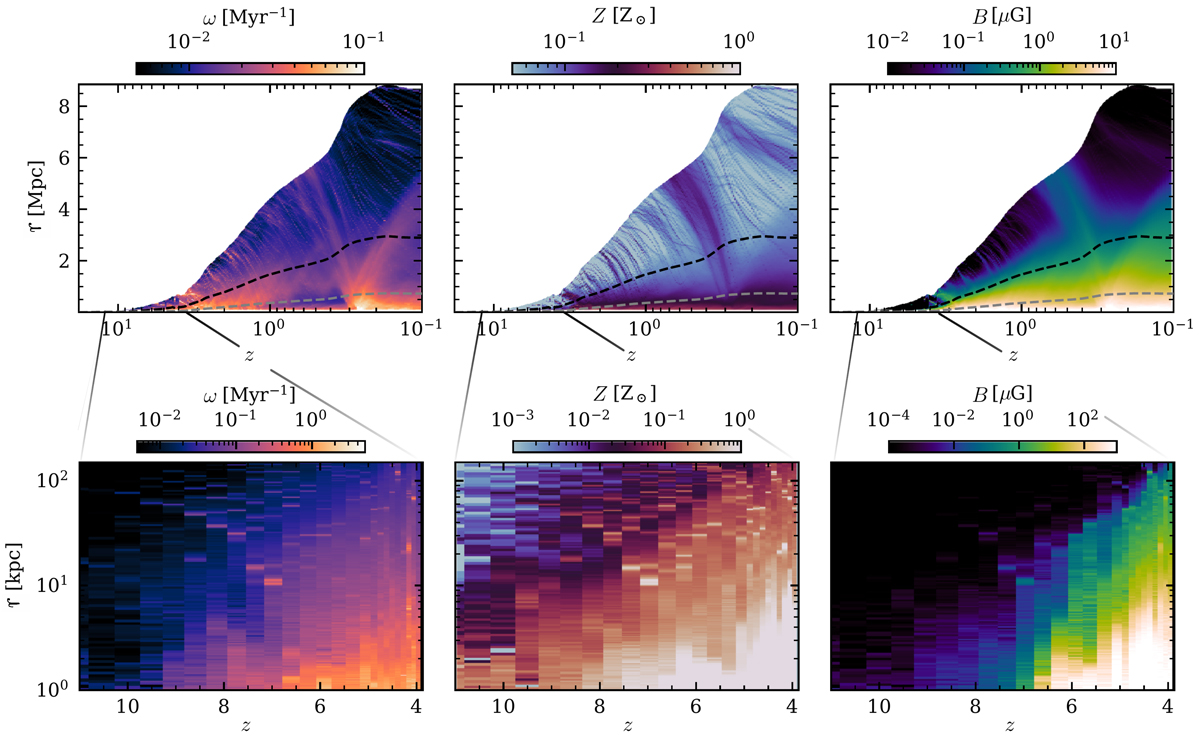
Redshift evolution of the physical radius corresponding to 3R200 (≈9 Mpc) surrounding the cluster in the radiative simulation of Halo3. From left to right, we color code the spherically averaged fields of vorticity, metallicity, and magnetic field strength. The upper row shows the redshift range 20 > z > 0.1, highlighting the late time evolution dominated by mergers, while the bottom row shows the redshift range 11 > z > 4, focusing on the evolution in the central galaxy at higher redshifts. The dashed lines indicate the virial radius (R200) and the central cluster region (0.25R200). We keep the maximum radius in the lower panels at a fixed physical value of 150 kpc (see text). The lower panels show how vorticity and metallicity are enhanced in the center already at high redshifts, z > 9. The central magnetic field amplification sets in shortly afterwards at z ≈ 7. Turbulence from gravitational infall of cool gas amplifies the magnetic field and drives a small-scale dynamo. Stellar feedback additionally injects turbulence, distributes metals, and mixes magnetically enriched gas with less enriched gas. The upper panel highlights how merging substructures contribute their magnetically enriched gas to the host cluster. These merging structures also exhibit higher metallicity, indicating the connection between strong magnetic fields and the metal-rich ISM.
Current usage metrics show cumulative count of Article Views (full-text article views including HTML views, PDF and ePub downloads, according to the available data) and Abstracts Views on Vision4Press platform.
Data correspond to usage on the plateform after 2015. The current usage metrics is available 48-96 hours after online publication and is updated daily on week days.
Initial download of the metrics may take a while.