


Fig. 7.
Download original image
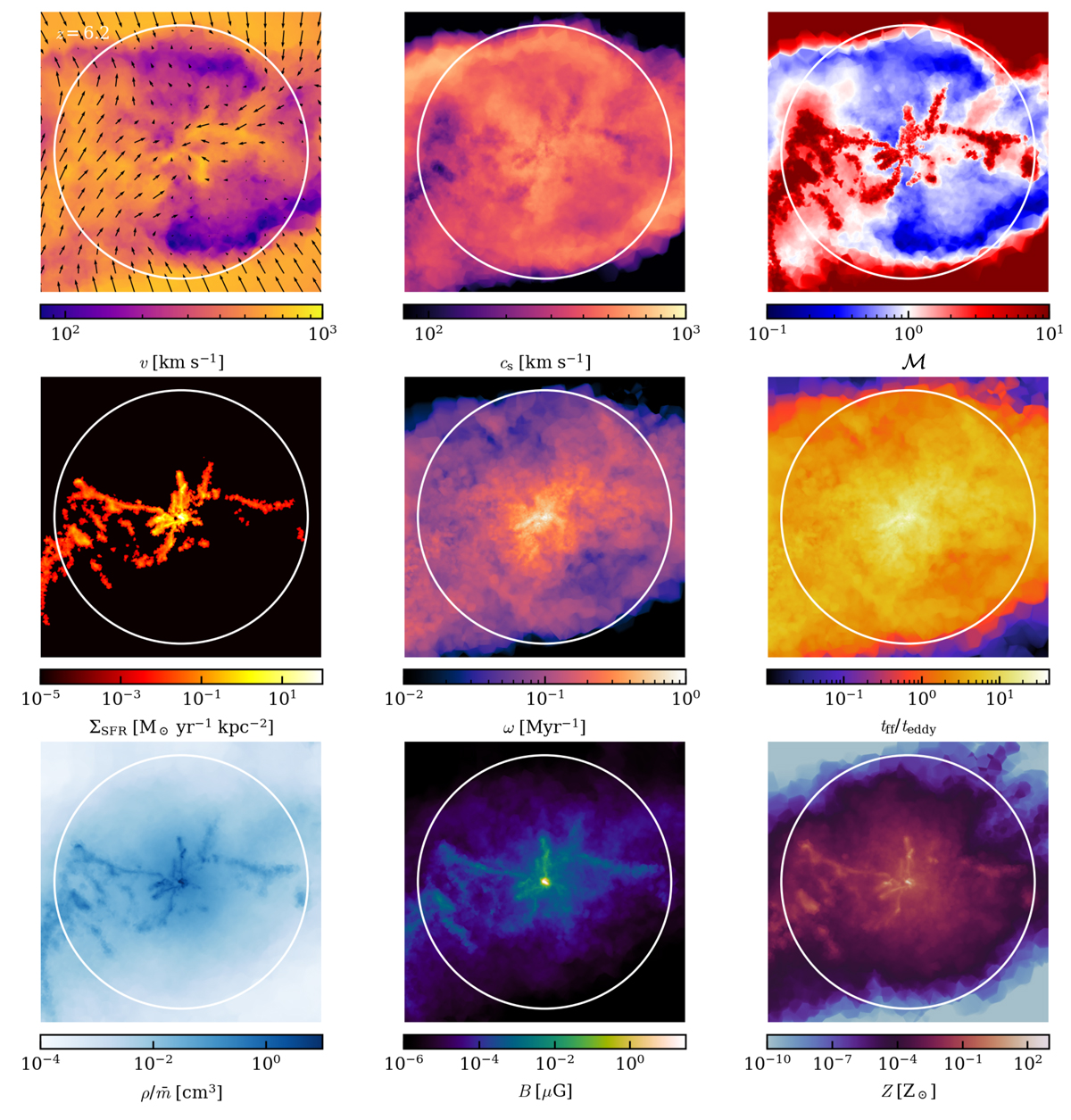
Thin projections through the center of Halo3 in the radiative simulation with sidelength 2.2R200 at z = 6.2 and thickness 0.5R200. From top left to bottom right, the nine panels display the gas velocity in the cluster rest frame, sound speed, Mach number, star formation rate surface density, vorticity, the ratio of the free-fall time to the eddy-turnover time, particle number density, magnetic field strength, and metallicity. The velocity field is shown together with its absolute value in the first panel. Regions with cold, supersonic gaseous inflows create vorticity and display strong magnetic fields. Star formation in the high density regions creates stellar feedback driven winds that interact with the inflowing gas and produce vorticity. This vorticity efficiently mixes highly magnetized gas with weaker magnetized gas, distributing metals across the cluster.
Current usage metrics show cumulative count of Article Views (full-text article views including HTML views, PDF and ePub downloads, according to the available data) and Abstracts Views on Vision4Press platform.
Data correspond to usage on the plateform after 2015. The current usage metrics is available 48-96 hours after online publication and is updated daily on week days.
Initial download of the metrics may take a while.