


Fig. 9
Download original image
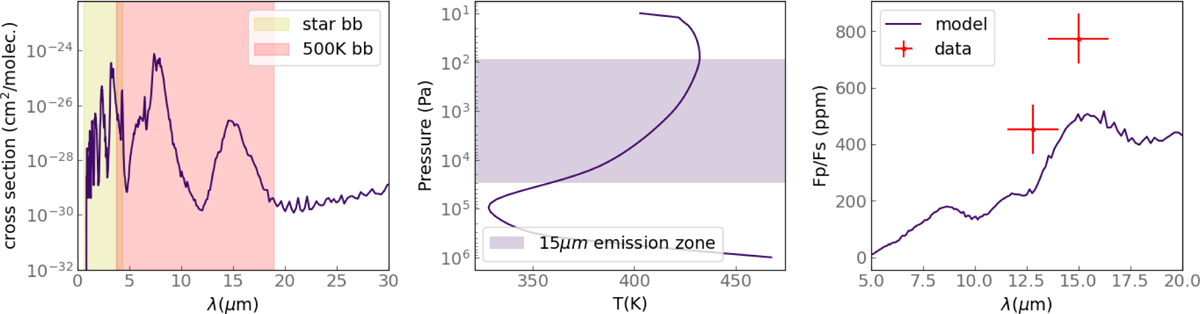
1D case of thermal inversion (10 bar, N2+40% CH4+0.4%CO2). Left: opacity of the atmosphere with the zone of emission of the star and the planet. Middle: temperature profile and the layers of emission of the atmosphere at 15 µm. Right: eclipse depth. The methane absorbs partly in the star-emission region, creating the thermal inversion in the temperature profile. The CO2 absorbs in the 15 µm band, and thus the emission layers at 15 µm are high enough in the atmosphere, where the temperature is high. Thus, the eclipse depth is higher.
Current usage metrics show cumulative count of Article Views (full-text article views including HTML views, PDF and ePub downloads, according to the available data) and Abstracts Views on Vision4Press platform.
Data correspond to usage on the plateform after 2015. The current usage metrics is available 48-96 hours after online publication and is updated daily on week days.
Initial download of the metrics may take a while.