


Fig. 7.
Download original image
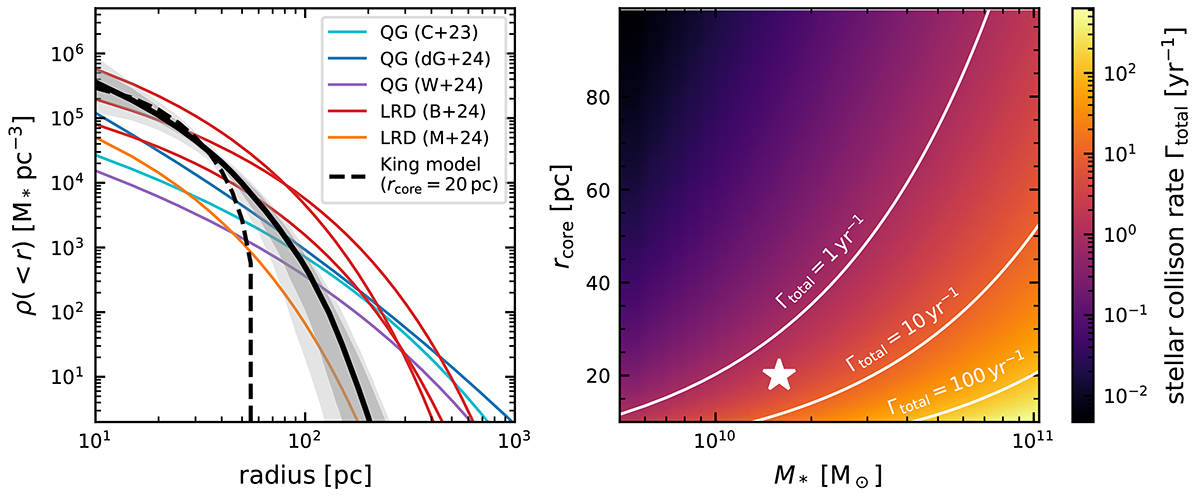
Left: Stellar mass density profiles of The Cliff (black solid and grey shaded areas respectively indicate 16–84 and 5–95 percentiles), a selection of compact massive quiescent galaxies at z > 4 (cyan, blue, and purple lines; Carnall et al. 2023; de Graaff et al. 2025b; Weibel et al. 2025), and LRDs with strong Balmer breaks from the literature (orange and red lines; Baggen et al. 2024; Ma et al. 2025). The stellar mass densities of LRDs, under the assumption that the rest-optical is dominated by stars, exceed the densities in the cores of massive quiescent galaxies by an order of magnitude. Right: Stellar collision rate Γtot as a function of the core radius (as defined in the King model) and stellar mass of the system, for a ∼500 Myr old stellar population. The inner ≲50 pc of The Cliff can be well approximated with a King model of rcore ∼ 20 pc; the location of the star corresponds to the dashed line shown in the left panel. If the stellar mass is as high as implied by the SED modelling of Section 5, we expect stellar collisions to occur at a frequency of ∼5 yr−1 (a factor of ∼105 greater than for the Milky Way’s nuclear star cluster).
Current usage metrics show cumulative count of Article Views (full-text article views including HTML views, PDF and ePub downloads, according to the available data) and Abstracts Views on Vision4Press platform.
Data correspond to usage on the plateform after 2015. The current usage metrics is available 48-96 hours after online publication and is updated daily on week days.
Initial download of the metrics may take a while.