


Fig. 9.
Download original image
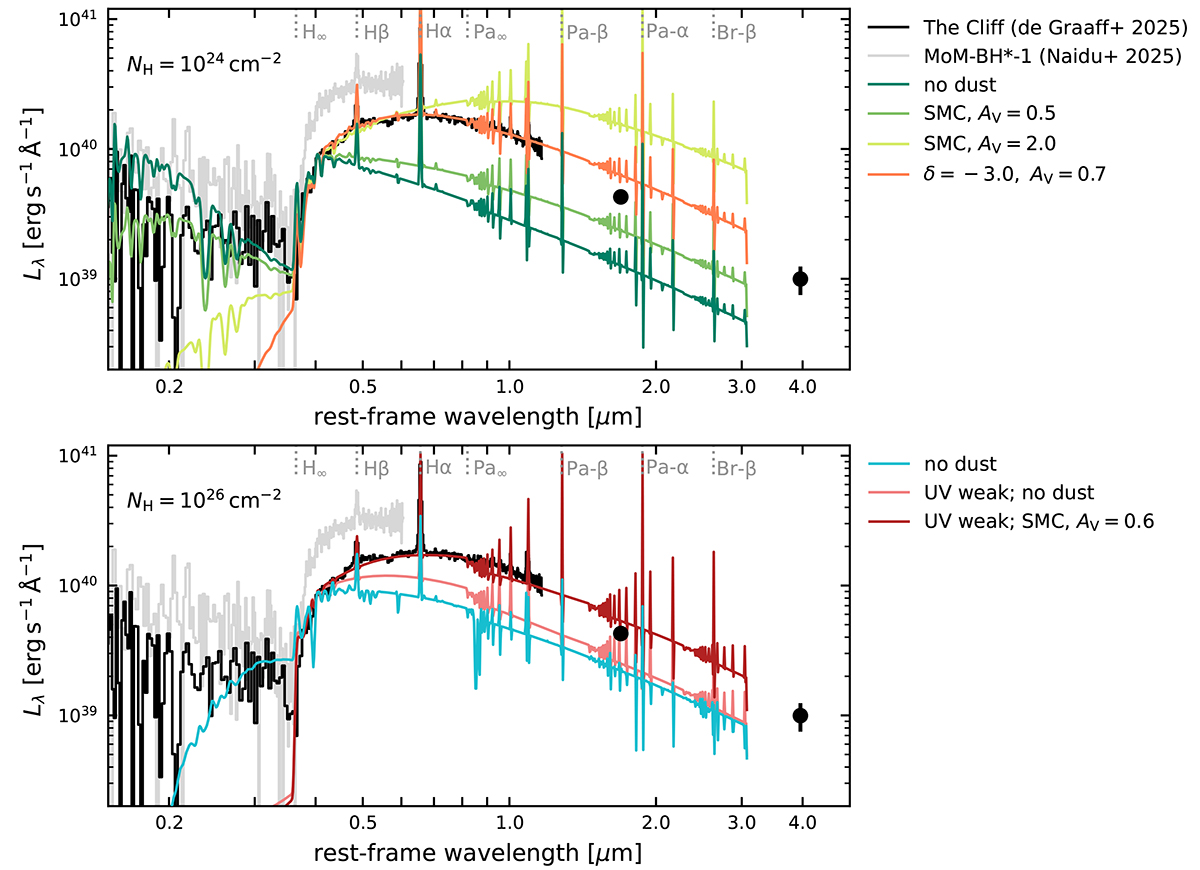
NIRSpec/PRISM spectra of The Cliff and MoM-BH*-1 (zspec = 7.76; Naidu et al. 2025). They are remarkably similar in shape, and only differ by a factor of ∼2 in luminosity. Top: BH* star model of a blue incident AGN spectrum (αX = −1.5, αUV = −0.5) with high column density of NH = 1024 cm−2 (rescaled to the rest [4000,4100] Å flux of The Cliff and convolved to PRISM resolution) yields an intrinsically strong Balmer break (dark green) that matches the spectrum better than any of the stellar spectra explored (Figure 8). Steep dust curves are required to match the shape of the spectrum blueward of ∼4200 Å (green), and high optical depths are needed to be able to match the curvature of the rest-optical spectrum (light green, orange). However, such strongly dust-reddened AGN models result in a severe discrepancy in the rest near-IR. Bottom: Increased absorption from dense gas (NH = 1026 cm−2) results in extra reddening of the spectra without the need for dust (blue line), but the Balmer break of this model does not match the spectrum. A UV-weak incident AGN spectrum (αX = −0.5, αUV = −0.1) can produce a strong Balmer break as well as a redder rest near-IR, although small mismatches in the IR remain even after modest dust attenuation (red lines). This suggests a redder intrinsic AGN spectrum (as predicted by some super-Eddington accretion disc models), or additional component in the SED such as (super)massive stars, is needed to explain The Cliff.
Current usage metrics show cumulative count of Article Views (full-text article views including HTML views, PDF and ePub downloads, according to the available data) and Abstracts Views on Vision4Press platform.
Data correspond to usage on the plateform after 2015. The current usage metrics is available 48-96 hours after online publication and is updated daily on week days.
Initial download of the metrics may take a while.