


Fig. B.2
Download original image
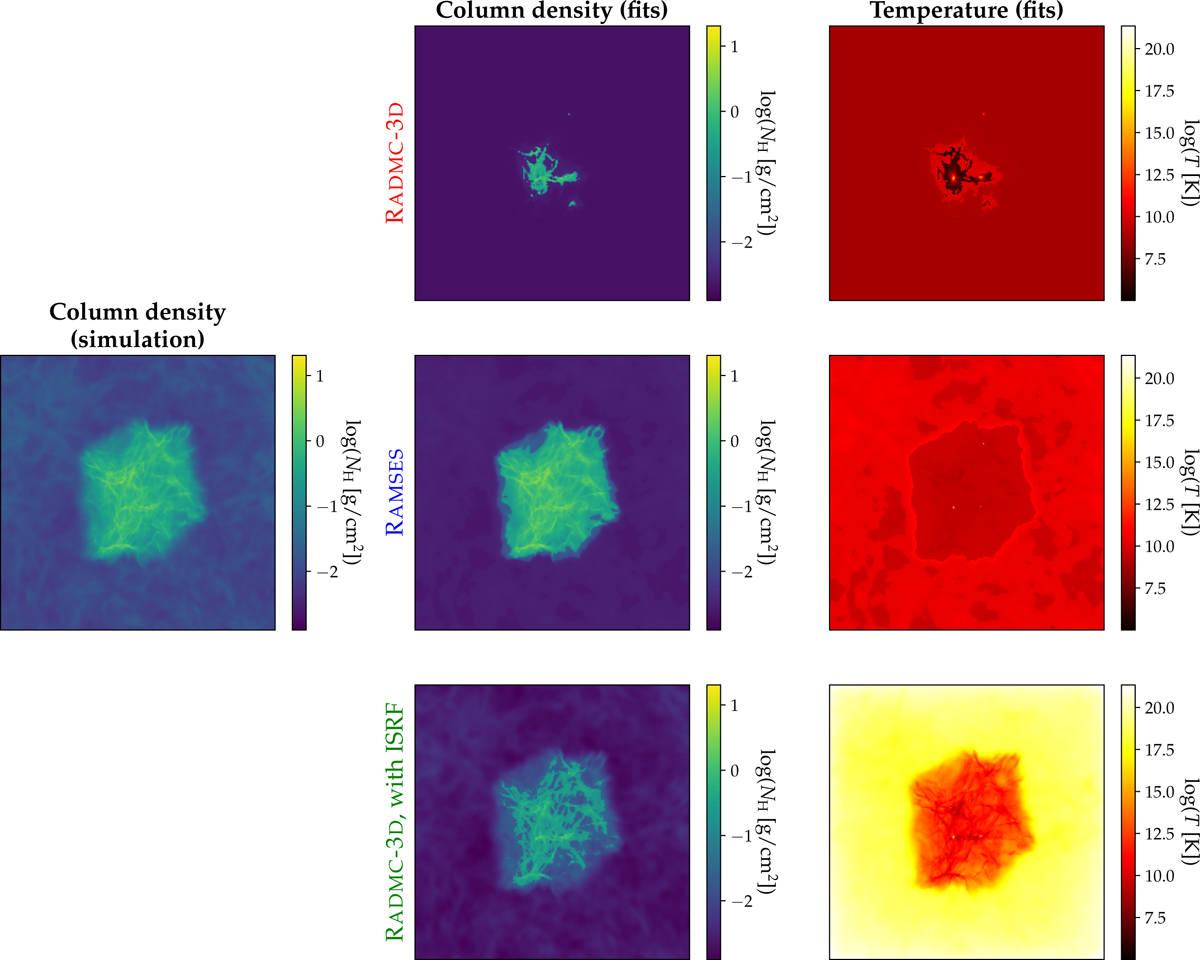
Pixel-by-pixel fitting results for the temperature (right column) and column density (middle column) in the first very output of the fiducial model, in comparison with the original column density from the simulation (left column). Three temperature distributions of the dust are considered for the ray-tracing to obtain the dust emission: one obtained with Radmc−3d thermal MC computations (top row) with stars as the only photon sources, one taken directly from the gas temperature in the Ramses simulation (middle row), and one with the Radmc−3d thermal MC using the ISRF as an additional heating source (bottom row). The Radmc−3d profile without ISRF produces insufficient heating inside the clumps in comparison with the imposed 10 K temperature imposed at the beginning of the simulation, resulting in the low fluxes and consequently low mass reproduced. The inclusion of the solar neighborhood ISRF in the Radmc−3d MC treatment, on the other hand, overheats the outskirts of the clump to a much higher temperature than the inside, while still not resulting in an adequate estimate of the mass contained within the latter.
Current usage metrics show cumulative count of Article Views (full-text article views including HTML views, PDF and ePub downloads, according to the available data) and Abstracts Views on Vision4Press platform.
Data correspond to usage on the plateform after 2015. The current usage metrics is available 48-96 hours after online publication and is updated daily on week days.
Initial download of the metrics may take a while.