


Fig. 4
Download original image
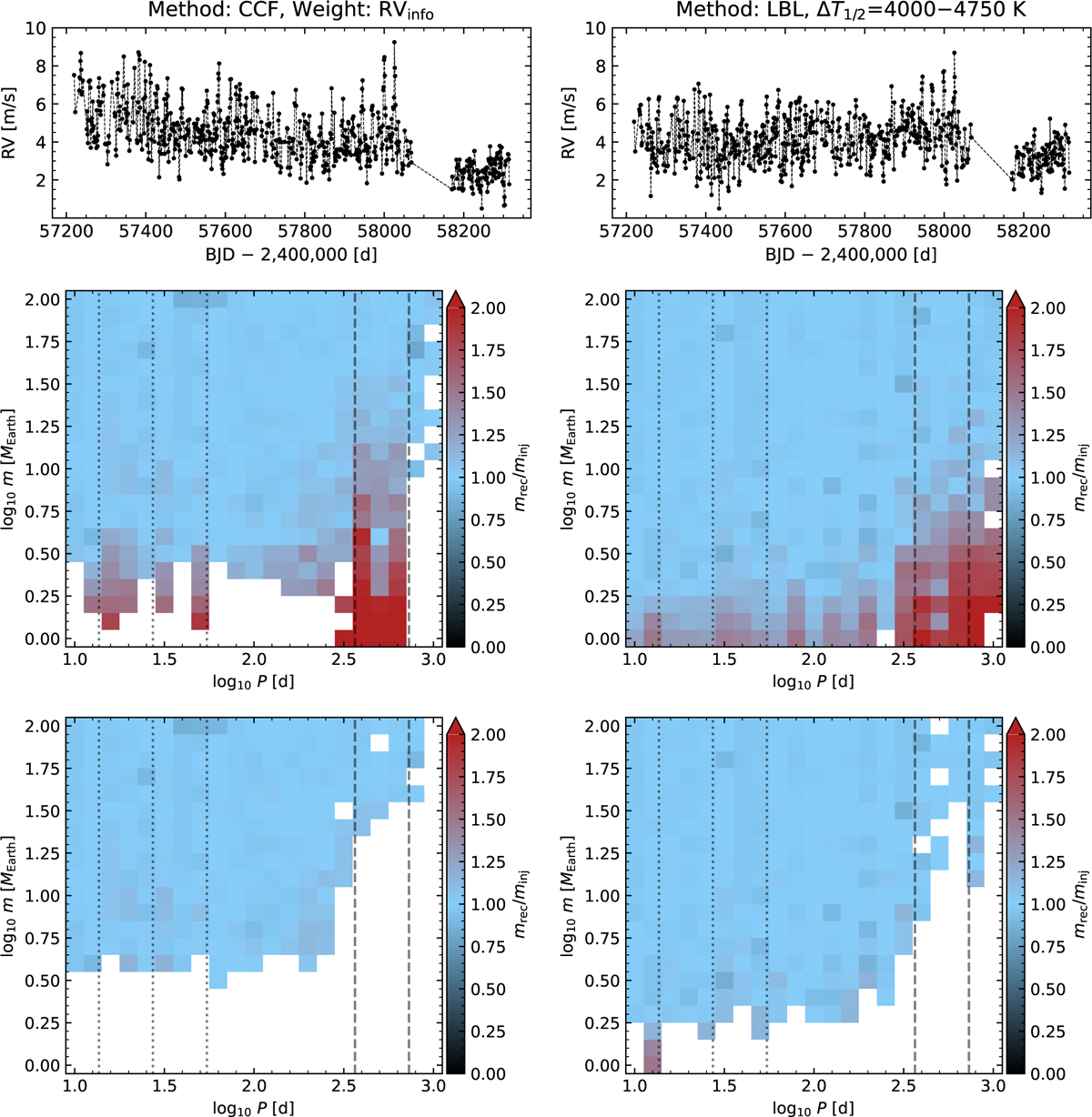
Planetary detection limits for two different RV extraction methods applied on the same HARPS-N data set. Upper left panel: RVs extracted using a CCF weighted with the RV content of each mask line. Upper right panel: RVs extracted using the LBL technique considering line parts with average formation temperatures between 4000–4750 K (see main text for details about the choice of temperature bin). Central left panel: injection-recovery test applied to the CCF RVs (upper left panel) using planets with periods between 10–1000 d and masses between 1–100 m⊕. The color indicates the ratio between the recovered and injected planetary masses for planets considered to be recovered; parameter combinations in white indicate planets which were not recovered. The displayed results are the average of ten trials with randomized orbital phases, for which the injected planets were detected in at least one of the trials. The dotted lines indicate the synodic solar rotation period, Prot,⊙ ≈ 27 d, its first harmonic at Prot,⊙/2 and its first multiple at 2Prot,⊙, and the dashed lines indicate the Earth orbital period, Porb,⊕ ≈ 365 d, and its first multiple at 2Porb,⊕. Central right panel: same as the central left panel, but applied to the LBL RVs (upper right panel). Lower left panel: same as the central left panel, but where the results are averaged over the injected planets which were detected in strictly all of the trials. Lower right panel: same as the lower left panel, but applied to the LBL RVs (upper right panel).
Current usage metrics show cumulative count of Article Views (full-text article views including HTML views, PDF and ePub downloads, according to the available data) and Abstracts Views on Vision4Press platform.
Data correspond to usage on the plateform after 2015. The current usage metrics is available 48-96 hours after online publication and is updated daily on week days.
Initial download of the metrics may take a while.