


Fig. A.1
Download original image
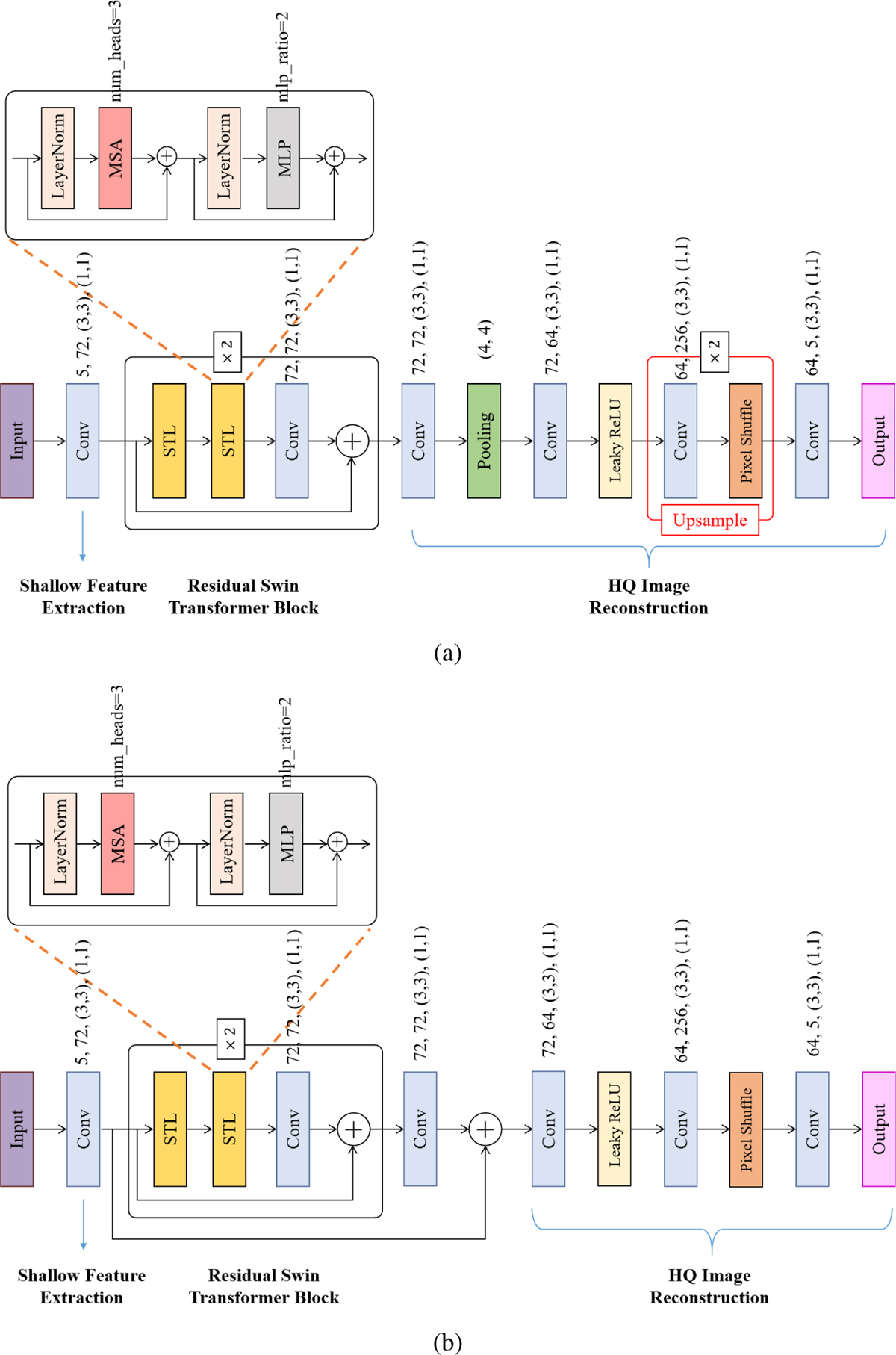
Architectures of the Swin Transformer for the S2S and S2C translations, illustrated in subfigures (a) and (b), respectively. The three components of the Swin Transformer are shown, i.e. a shallow feature extraction module, residual Swin Transformer blocks (RSTBs), and a high-quality (HQ) image reconstruction module. The shallow feature extraction module is a convolutional layer. Two RSTBs are implemented, each composed of two Swin Transformer layers (STLs) and a convolutional layer. Each STL contains a multi-head self-attention (MSA) unit with three attention heads, two layer normalization (LayerNorm) operations, a multilayer perceptron (MLP) with an MLP ratio of 2, and two skip connections. The HQ image reconstruction module mainly consists of convolutional layers. For the S2S translation, a 4 × 4 average pooling layer for downsampling and two pixel shuffle layers for upsampling are implemented. For the S2C translation, a pixel shuffle layer is implemented, and there is a skip connection that directly links the shallow feature extraction module to the HQ image reconstruction module. The blocks that are repeated multiple times are marked with “×N”. The leaky rectified linear unit (Leaky ReLU) activation has a leaky ratio of 0.01. The numbers next to each convolutional layer refer to the number of input channels, the number of output channels, the kernel size, and the stride. For instance, “5, 72, (3,3), (1,1)” means that a convolutional layer has five input channels and 72 output channels, in which 3 × 3 kernels and 1 × 1 strides are implemented. The “same” padding is applied in all the convolutional layers.
Current usage metrics show cumulative count of Article Views (full-text article views including HTML views, PDF and ePub downloads, according to the available data) and Abstracts Views on Vision4Press platform.
Data correspond to usage on the plateform after 2015. The current usage metrics is available 48-96 hours after online publication and is updated daily on week days.
Initial download of the metrics may take a while.