


Fig. C.1
Download original image
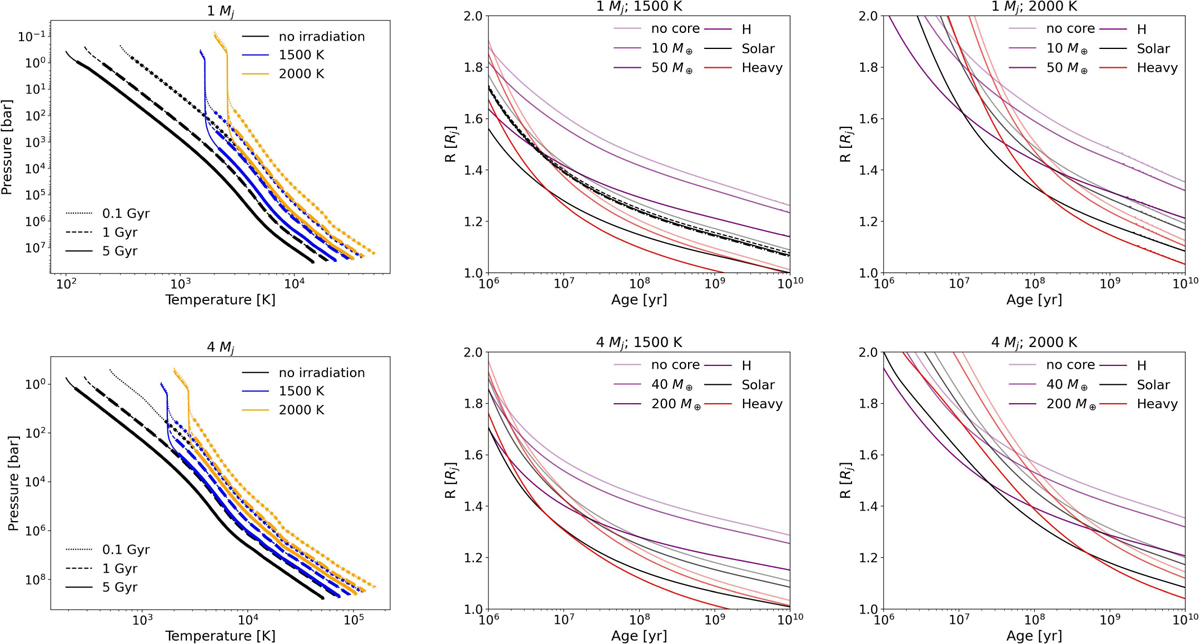
Evolution of irradiated HJs with no additional heating, εj = 0, for models with M = 1 Mj, ρc = 10 g cm−3 (top row) or M = 4 Mj, ρc = 45 g cm−3 (bottom row). Left panels: p(T) profiles at ages t ~ 0.1, 1 and 5 Gyr (dots, dashes, solid lines, respectively), comparing the cases without (black) and with irradiation, Teq = 1500 K (blue) and 2000 K (orange), all with solar composition. The thicker lines correspond to the convective zone, which extends from the RCB (p ~ 1 - 103 bar) to the outer core (p > 107 bar). Central panels: Radius evolution of planets with Teq = 1500 K and different core masses (Mc = 0,10 (M/Mj), 50 (M/Mj) Me, increasing for darker shades, all with solar composition) and composition of the envelope: pure hydrogen (purple), solar (black) and higher helium and heavier elements content, (Y, Z) = (0.35,0.035) (purple, black and red, respectively, all with Mc = 10 Mφ). In the top central panel we also show the effects of variation of ρc = 5 g cm−3 (dashes) and ρc = 20 g cm−3 (dot-dashed lines) for the representative Mc = 10 Me, solar composition case: since the effect is rather small compared to varying other parameters, we show it only in that particular panel. Right panels: Same as the central panels, but for Teq = 2000 K.
Current usage metrics show cumulative count of Article Views (full-text article views including HTML views, PDF and ePub downloads, according to the available data) and Abstracts Views on Vision4Press platform.
Data correspond to usage on the plateform after 2015. The current usage metrics is available 48-96 hours after online publication and is updated daily on week days.
Initial download of the metrics may take a while.