


Fig. 3
Download original image
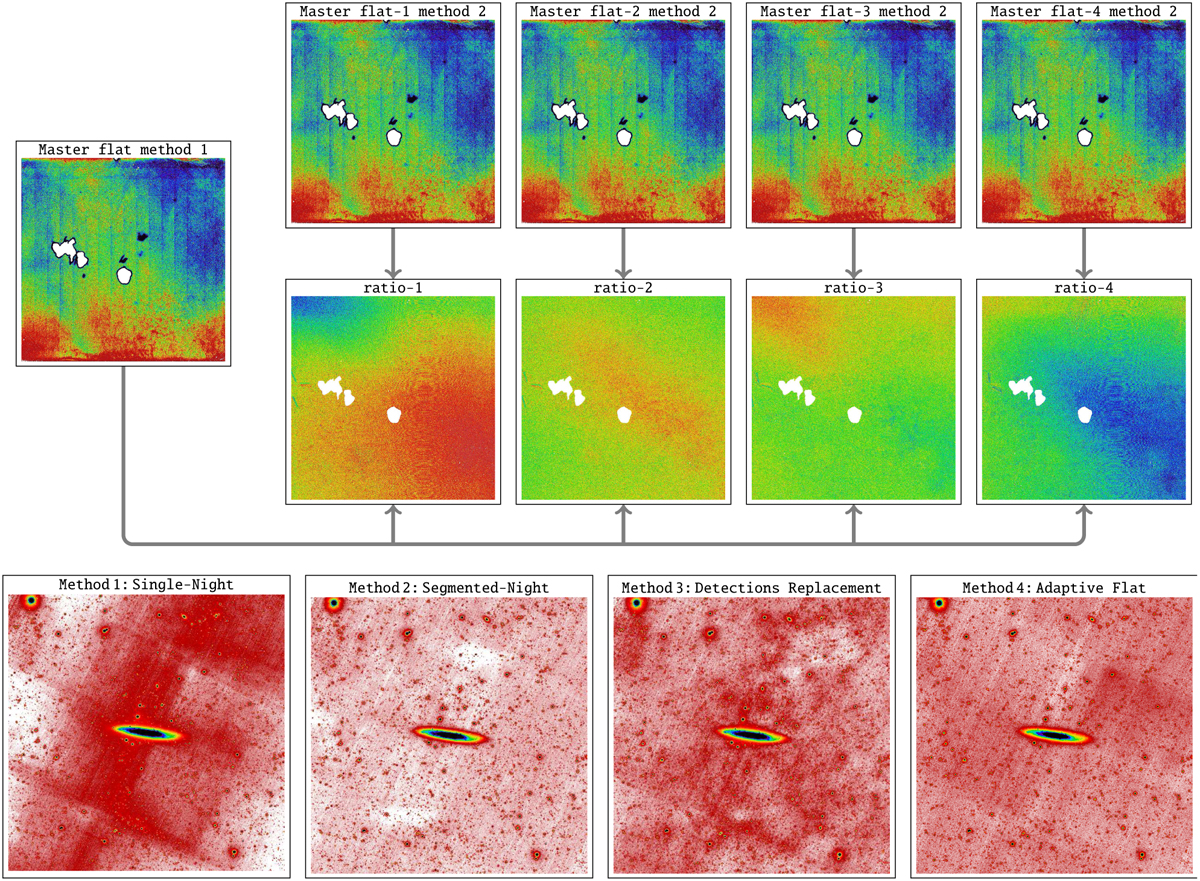
Illustration of flat-fielding strategies and their outcomes in the NASIM pipeline. Top panels: ratios of segmented-night master flats (second method) to the single-night master flat (first method), revealing significant sky variations over approximately one hour within a single night. These fluctuations highlight the need for special flat-fielding techniques. Bottom panels: final coadded images using different flat-fielding methods, each covering 0.28 × 0.28 deg2 and centred on the galaxy IC 2000 from KEDFS_1_5 tile: Method 1: Single-Night, preserves galaxy outskirts but retains large-scale gradients; Method 2: Segmented-Night, reduces gradients but suffers from persistence artefacts; Method 3: Detections Replacement, attempts to mitigate persistence effects, but introduces background inconsistencies; Method 4: Adaptive Flat, achieves the best balance, effectively reducing both gradients and persistence.
Current usage metrics show cumulative count of Article Views (full-text article views including HTML views, PDF and ePub downloads, according to the available data) and Abstracts Views on Vision4Press platform.
Data correspond to usage on the plateform after 2015. The current usage metrics is available 48-96 hours after online publication and is updated daily on week days.
Initial download of the metrics may take a while.