


Fig. 1.
Download original image
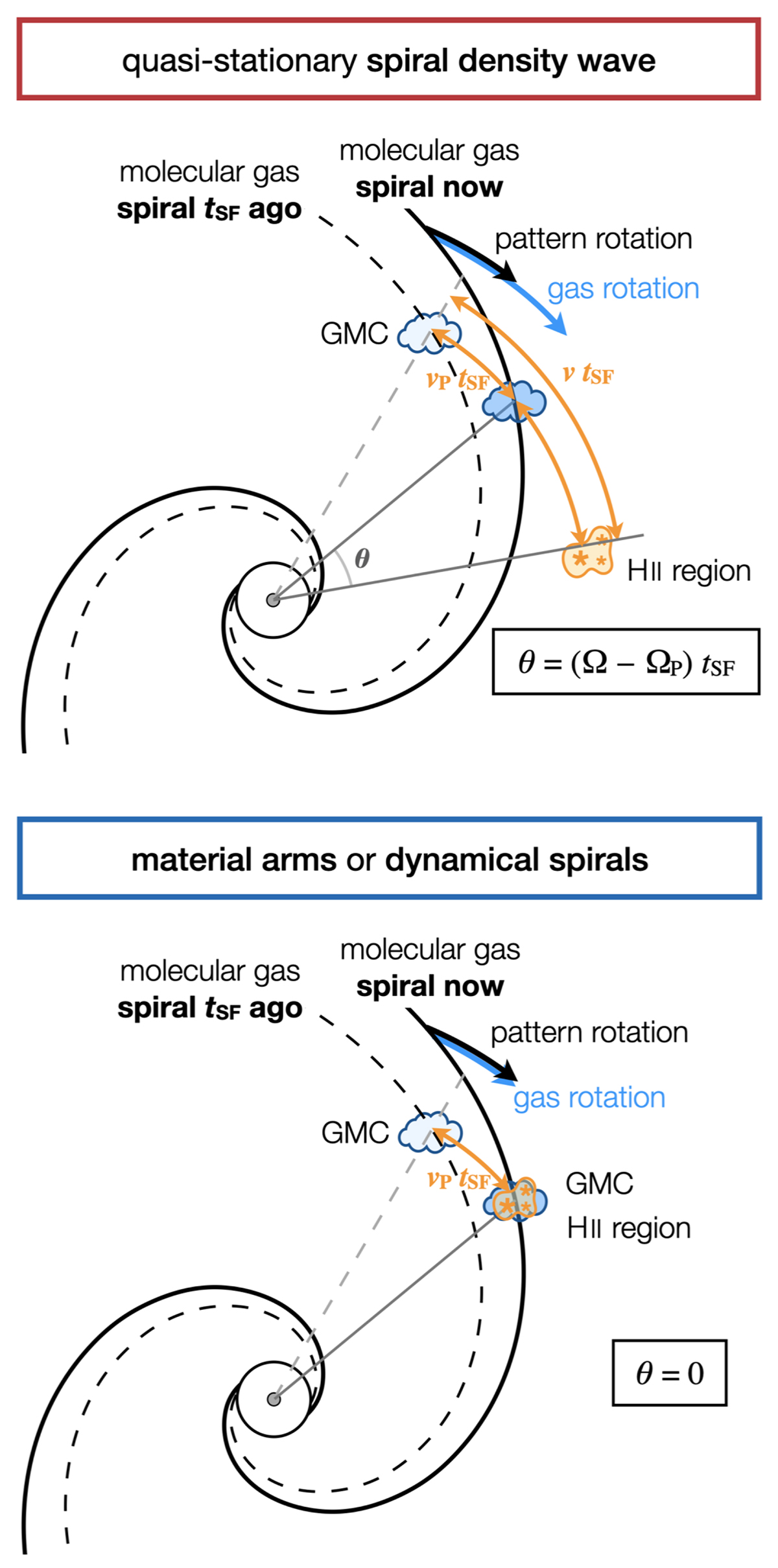
Top panel: Quasi-stationary spiral density wave theory predicts azimuthal offsets in spiral arms. The thick solid black line shows the current position of the molecular gas spiral, while the dashed line displays its position, tSF, earlier. If a shock coherently triggers the collapse of molecular gas along the spiral and if it takes tSF for the resulting HII regions to be visible, the peaks of star formation will be displaced ‘downstream’ inside co-rotation. Measuring offsets at different galactocentric radii, one can calculate the (constant) pattern speed of the spiral and star formation timescale tSF Egusa et al. 2009. If multiple overlapping spiral modes are present in the disc, the situation illustrated in the top panel will apply for a limited radial range, with different pattern speeds operating at different radial zones. Bottom panel: Situation expected for material arms or dynamical spirals, where the spiral rotates at the same angular speed as the underlying disc material and therefore no bulk offsets are expected. In real galaxies, the fact that star formation is not limited to a coherent spiral shock introduces significant scatter in the offset measurements in both cases.
Current usage metrics show cumulative count of Article Views (full-text article views including HTML views, PDF and ePub downloads, according to the available data) and Abstracts Views on Vision4Press platform.
Data correspond to usage on the plateform after 2015. The current usage metrics is available 48-96 hours after online publication and is updated daily on week days.
Initial download of the metrics may take a while.