


Fig. 2.
Download original image
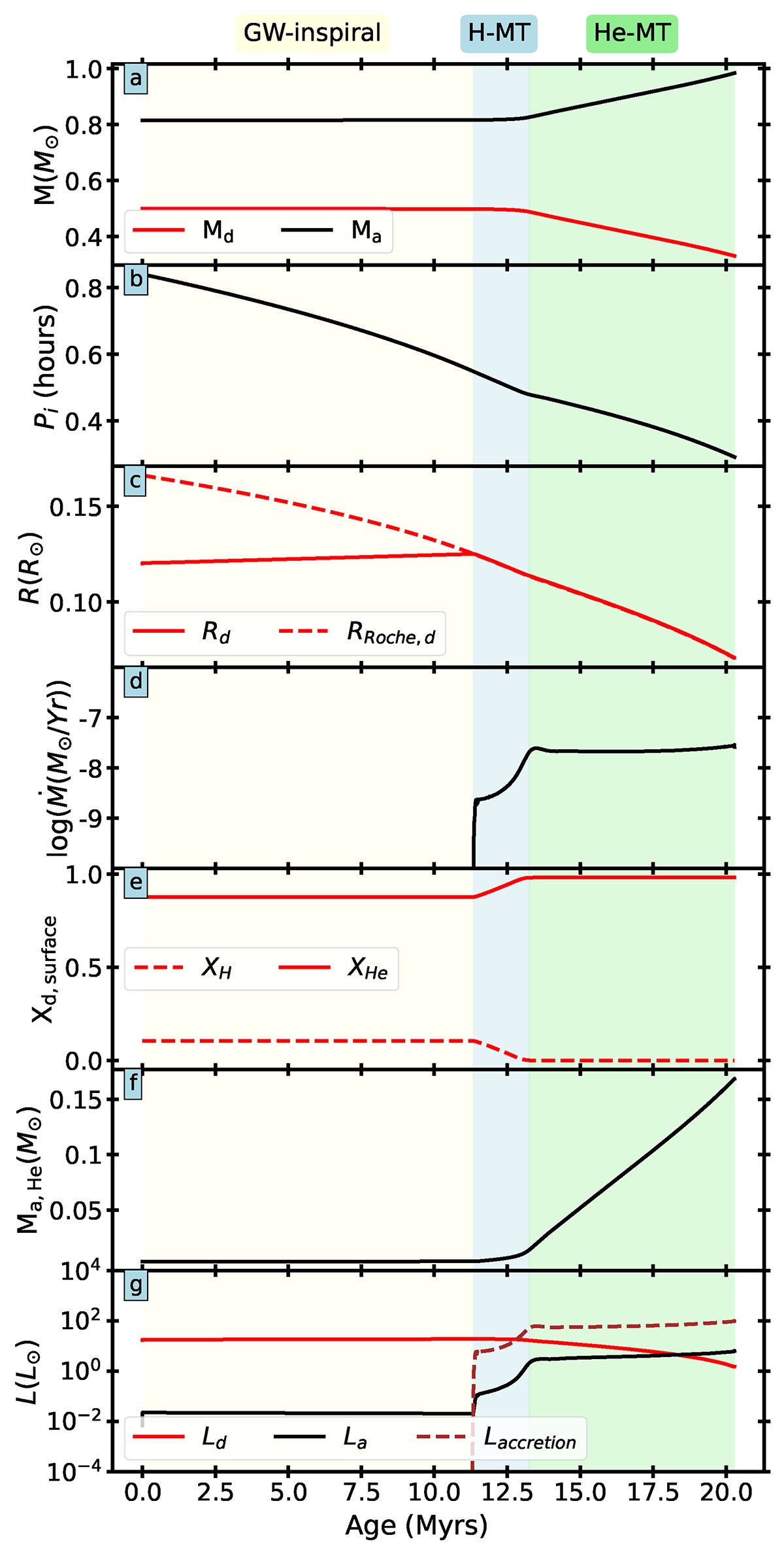
Example of a binary with Md = 0.5 M⊙, Ma = 0.8 M⊙, and Pi = 0.84 hours, where a thermonuclear explosion occurs in the WD (accretor). The background colors yellow, blue, and green represent the gravitational-wave inspiral phase (GW-inspiral), H mass transfer phase (H-MT), and He mass transfer phase (He-MT), respectively. Panels (a) through (f) show the evolution of various parameters: (a) Mass Evolution: Ma (accretor) and Md (donor); (b) Orbital Period Evolution; (c) Radius Evolution: Rd (donor’s radius) and Rroche, d (Roche radius of the donor); (d) mass transfer rate; (e) Evolution of surface mass fraction: XH (hydrogen) and XHe (helium) in the donor; (f) He Mass on the Accretor; (g) Luminosity Evolution: La (accretor), Ld (donor), and Laccretion (accretion). The accretor gains mass at the rate of ∼10−8 M⊙ yr−1, resulting in the He ignition in the He layers denser than the assumed critical density for detonation (> 106 g cm−3).
Current usage metrics show cumulative count of Article Views (full-text article views including HTML views, PDF and ePub downloads, according to the available data) and Abstracts Views on Vision4Press platform.
Data correspond to usage on the plateform after 2015. The current usage metrics is available 48-96 hours after online publication and is updated daily on week days.
Initial download of the metrics may take a while.