


Fig. 9
Download original image
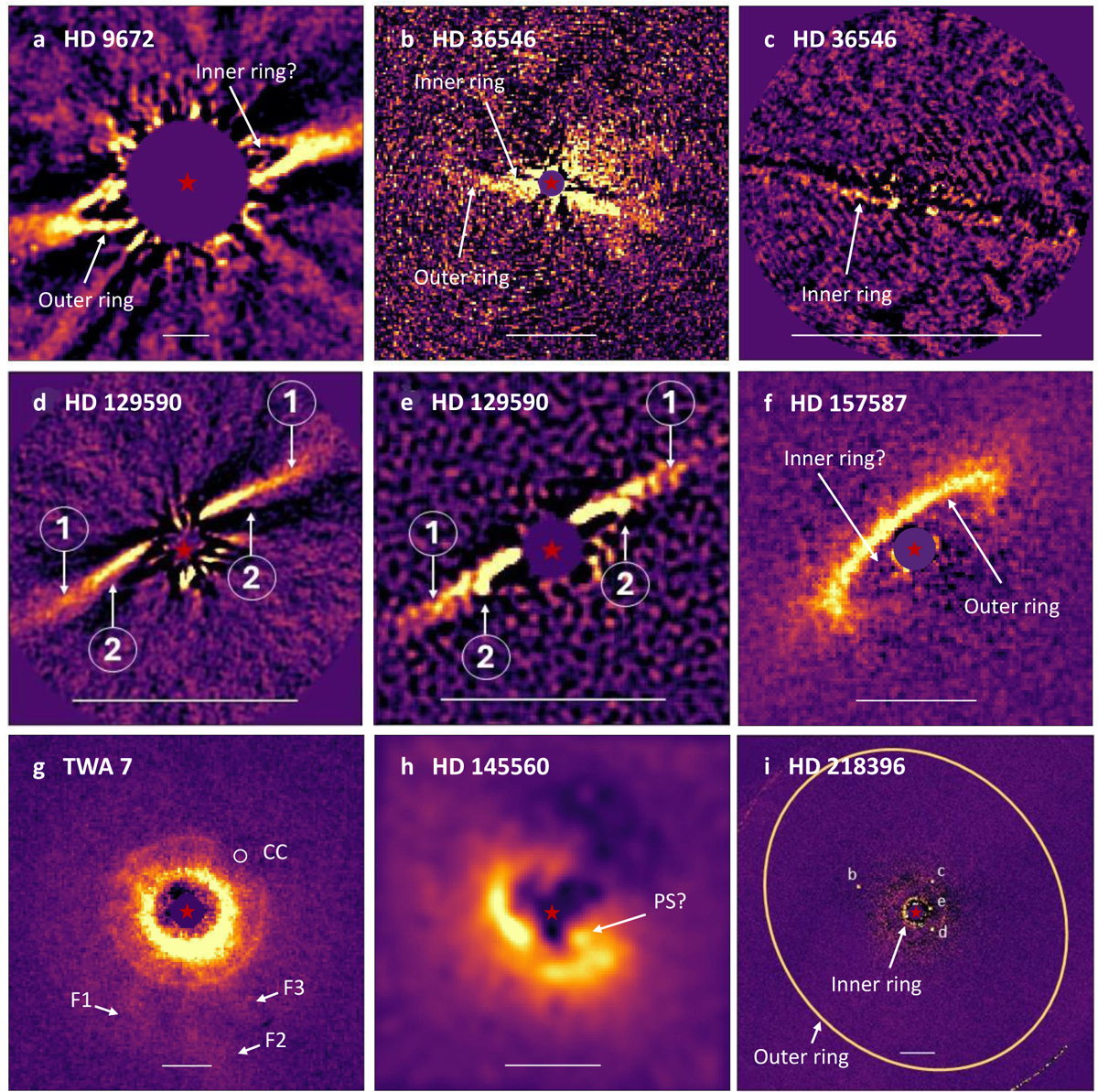
Images of debris disks with signs of multiple rings. The white bars in the lower parts of the images correspond to 1 arcsec. The positions of stars are marked by red asterisks. In panels d and e the outer belt is indicated by a number “1” and the inner belt by a number “2”. Panel a: the H2H3-filter total intensity image of debris disk HD 9672 (49 Ceti). Panel b: the H2H3-filter total intensity image of debris disk HD 36546. Panel c: the combined IFS total intensity image of inner belt around HD 36546. Panel d: the H-band total intensity image of debris disk HD 129590. Panel e: the H-band polarized intensity image of debris disk HD 129590. Panel f: the H-band polarized intensity image of debris disk HD 157587. Panel g: the H-band polarized intensity image of debris disk TWA 7. The position of the candidate planetary companion is labeled as “CC”. The labels “F1”, “F2” and “F3” indicate arc-like morphological features detected in the disk structure. Panel h: the VBB polarized intensity image of the HD 145560 debris disk. Panel i: the H-band Qϕ image of debris disk HD 218396 (HR 8799). The radial position of the outer belt at r = 4.5″ is schematically shown by the orange ellipse. The positions of planets HR 8799 b, c, d and e are taken from the total intensity image and overlaid over the Qϕ image.
Current usage metrics show cumulative count of Article Views (full-text article views including HTML views, PDF and ePub downloads, according to the available data) and Abstracts Views on Vision4Press platform.
Data correspond to usage on the plateform after 2015. The current usage metrics is available 48-96 hours after online publication and is updated daily on week days.
Initial download of the metrics may take a while.