


Fig. 2.
Download original image
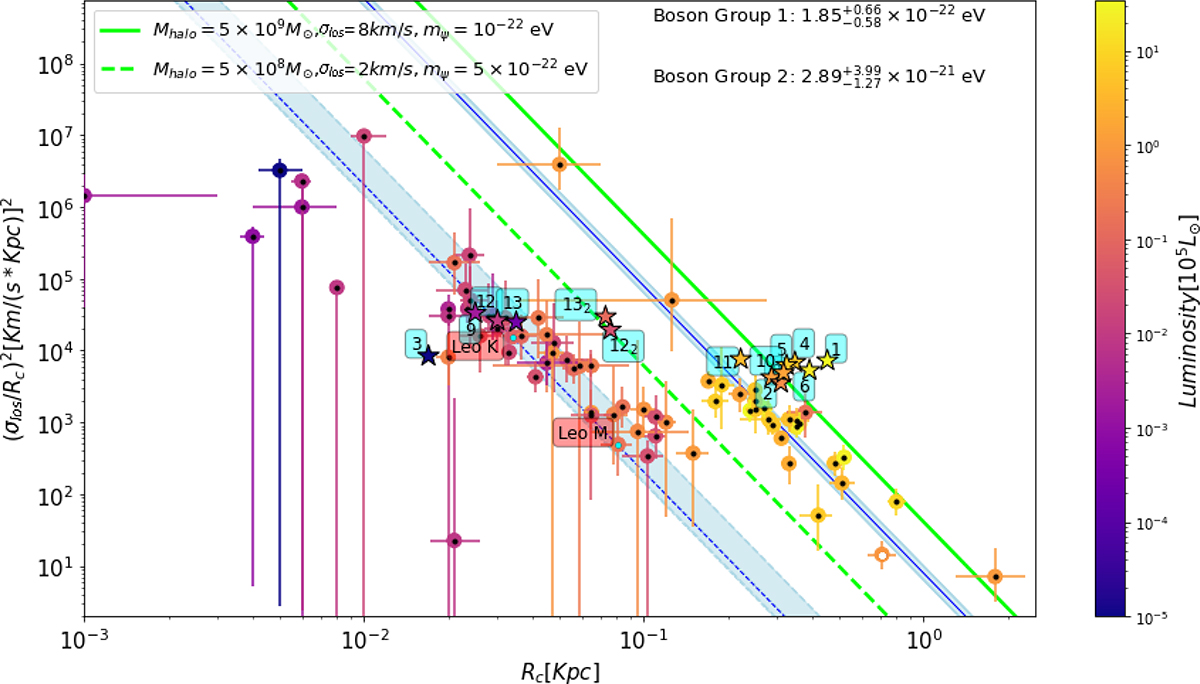
Density versus core radius. The central density is plotted within the fit core radius for each dwarf, estimated as (σc/rc)2. Since the values of σc are not available for the galaxy dataset, we used σlos instead. A clear separation between UFD’s and classical dSph’s is apparent with both populations following parallel trends. The slope d log ρc/d log rc = −4 corresponds to the time-independent soliton solution of the Schrödinger–Poisson equation, where more massive solitons produce narrower cores. The blue lines represent the predicted relation for the UFD’s and dSph’s, whereas the green lines correspond to the input boson masses of the simulation and can be compared with the star symbols (simulated halos) and halo ID number. In the case of halos, 122 and 132 represent halos 12 and 13 in a scenario where they do not experience tidal forces. Note how the dSph galaxies and the non-tidally affected extrapolated UFDs follow their theoretical trend lines. We also mark Leo K ( Kpc) and Leo M (
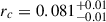 Kpc) galaxies and color-code them by luminosity; this plot provides a prediction of their predicted velocity dispersions, which are as yet unmeasured. Crater II is marked with a white point.
Current usage metrics show cumulative count of Article Views (full-text article views including HTML views, PDF and ePub downloads, according to the available data) and Abstracts Views on Vision4Press platform.
Data correspond to usage on the plateform after 2015. The current usage metrics is available 48-96 hours after online publication and is updated daily on week days.
Initial download of the metrics may take a while.