


Fig. 5.
Download original image
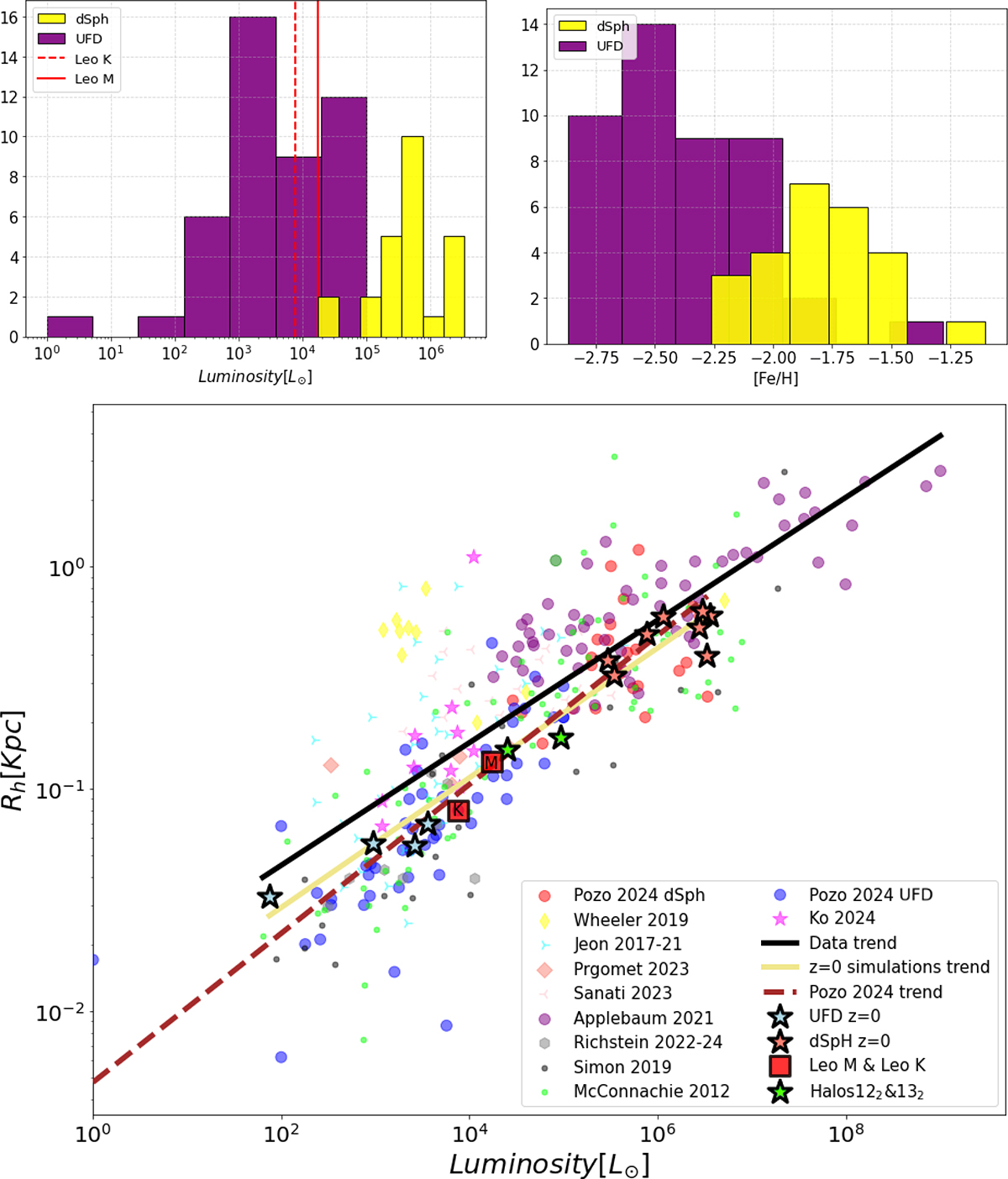
Top left panel: Histogram of luminosities of both galaxy classes. Each galaxy population has been colored differently – yellow for dSphs and purple for UFDs, respectively. We observe that, overall, both classes show a clear distinction in terms of luminosities, forming two separate groups. However, there is no sharp discrete transition between the classes, as some galaxies lie in an overlapping region. Top right panel: Histogram of metallicities of both galaxy classes. We observe the same trend as with the luminosities. Bottom panel: Luminosity versus 2D-projected half-light radius for simulated and observed galaxies. We compare our results (extrapolated to z = 0 from our latest simulation outputs at z = 3.4, marked with star-shaped points) with updated catalogs of observed UFD and dwarf galaxies from several works (McConnachie 2012; Simon 2019; Richstein et al. 2022), as well as with simulated galaxies from various studies (Jeon et al. 2017, 2021; Wheeler et al. 2019; Applebaum 2021; Prgomet 2022; Sanati et al. 2023; Go et al. 2025). Additionally, we included the galaxies analyzed in our previous work (Pozo et al. 2024). For our simulations, we derived the half-light-radius values based on typical proportions corresponding to each dwarf population (Pozo et al. 2024). We mark Leo K and Leo M with red squares and the locations of halos 122 and 132 with light-green star-shaped points. Note how these two halos still fall within the UFD range, with halo 122 showing similar properties to the recently discovered isolated Leo M UFD (halos 122 and 132 represent halos 12 and 13 in a scenario where they do not experience tidal forces; see Fig. 4).
Current usage metrics show cumulative count of Article Views (full-text article views including HTML views, PDF and ePub downloads, according to the available data) and Abstracts Views on Vision4Press platform.
Data correspond to usage on the plateform after 2015. The current usage metrics is available 48-96 hours after online publication and is updated daily on week days.
Initial download of the metrics may take a while.