


Fig. 2
Download original image
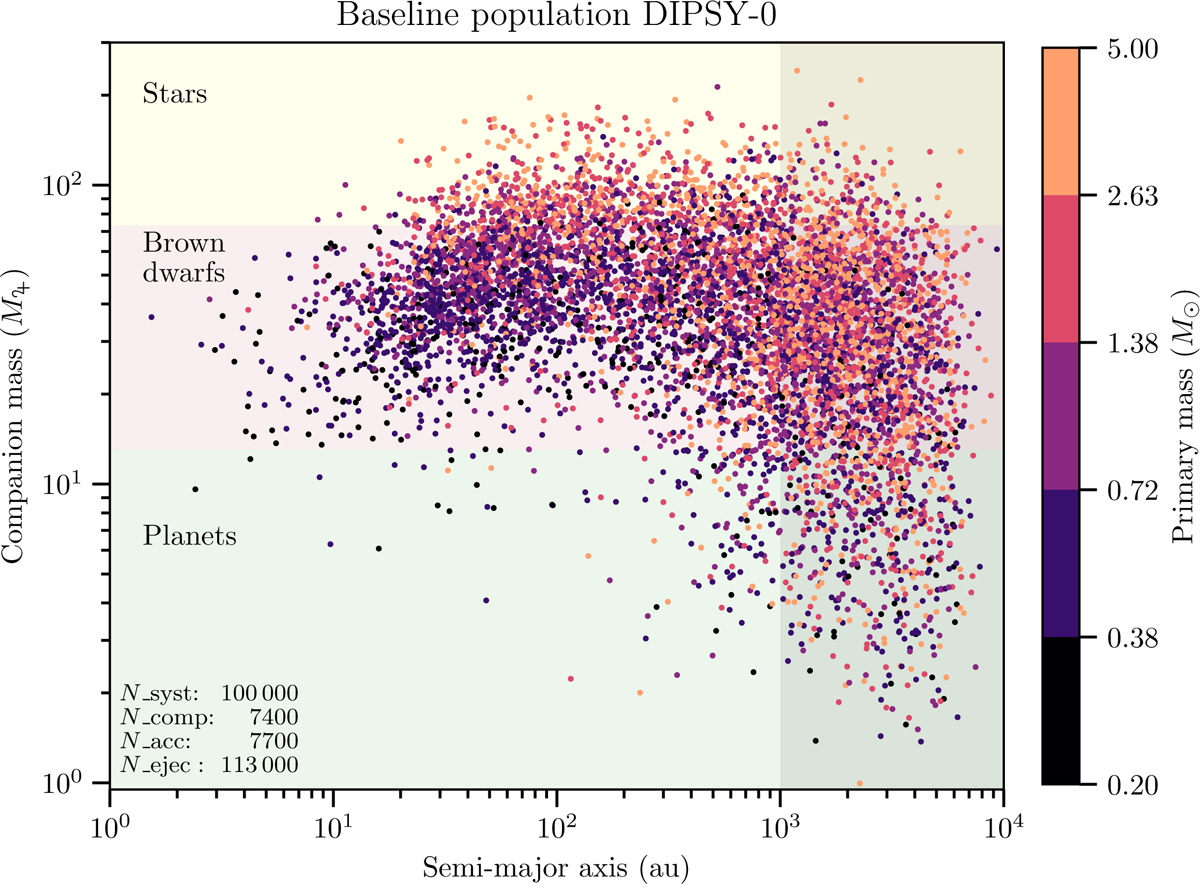
Mass vs. semi-major axis for all the surviving companions of the baseline population. The colour code of each companion gives the (final) mass of the primary (host star). Differences in occurrence rate due to the different weights of stellar masses according to the IMF are not reflected in this figure; instead, for each of the 100 stellar mass bins, ≈1000 systems containing a total of 7400 companions are shown. The number of systems (Nsyst), the number of surviving companions (Ncomp), the number of objects accreted on the primary (Nacc), and the number of ejected objects (Nejec) are given in the bottom left corner. The horizontal background colours indicate how the companions might be classified as stars, BDs, or planets according to their mass. Clearly, the distinction between these classes is not as clear-cut as these limits may suggest. Objects at very large separations (⪆ 1000 au) may not survive long enough to be observed, as the grey area suggests, as they can become unbound.
Current usage metrics show cumulative count of Article Views (full-text article views including HTML views, PDF and ePub downloads, according to the available data) and Abstracts Views on Vision4Press platform.
Data correspond to usage on the plateform after 2015. The current usage metrics is available 48-96 hours after online publication and is updated daily on week days.
Initial download of the metrics may take a while.