


Fig. 8
Download original image
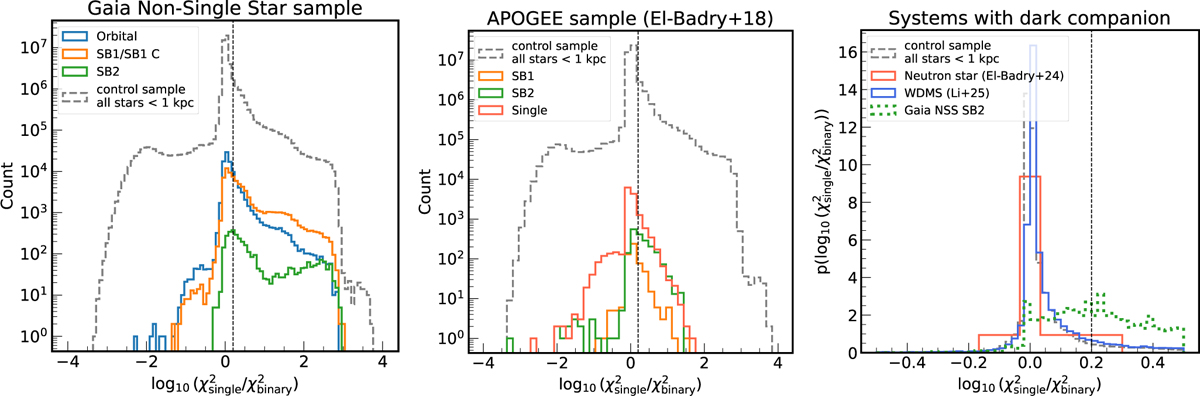
Distribution of the logarithmic χ2 improvement,  , showing the statistical evidence favoring binary over single-star spectral models. Left panel: distributions for Gaia DR3 NSS sources: systems with orbital solutions (blue), single-lined spectroscopic binaries (SB1/SB1C; orange), and double-lined spectroscopic binaries (SB2; green). Right panel: distributions for specialized populations with likely dark companions: neutron star binaries (El-Badry et al. 2024) (red) and WDMS (Li et al. 2025) (blue). The Gaia DR3 NSS SB2 sample (green dotted line) is shown for reference. Common elements in each panel: the distribution for all stars within 1 kpc (black dashed line) acts as a control representing the general population. A vertical dashed line marks 0.2 for reference. Higher values of the χ2 improvement indicate stronger evidence for binarity; known binaries typically show significant positive values.
Current usage metrics show cumulative count of Article Views (full-text article views including HTML views, PDF and ePub downloads, according to the available data) and Abstracts Views on Vision4Press platform.
Data correspond to usage on the plateform after 2015. The current usage metrics is available 48-96 hours after online publication and is updated daily on week days.
Initial download of the metrics may take a while.