


Fig. 7.
Download original image
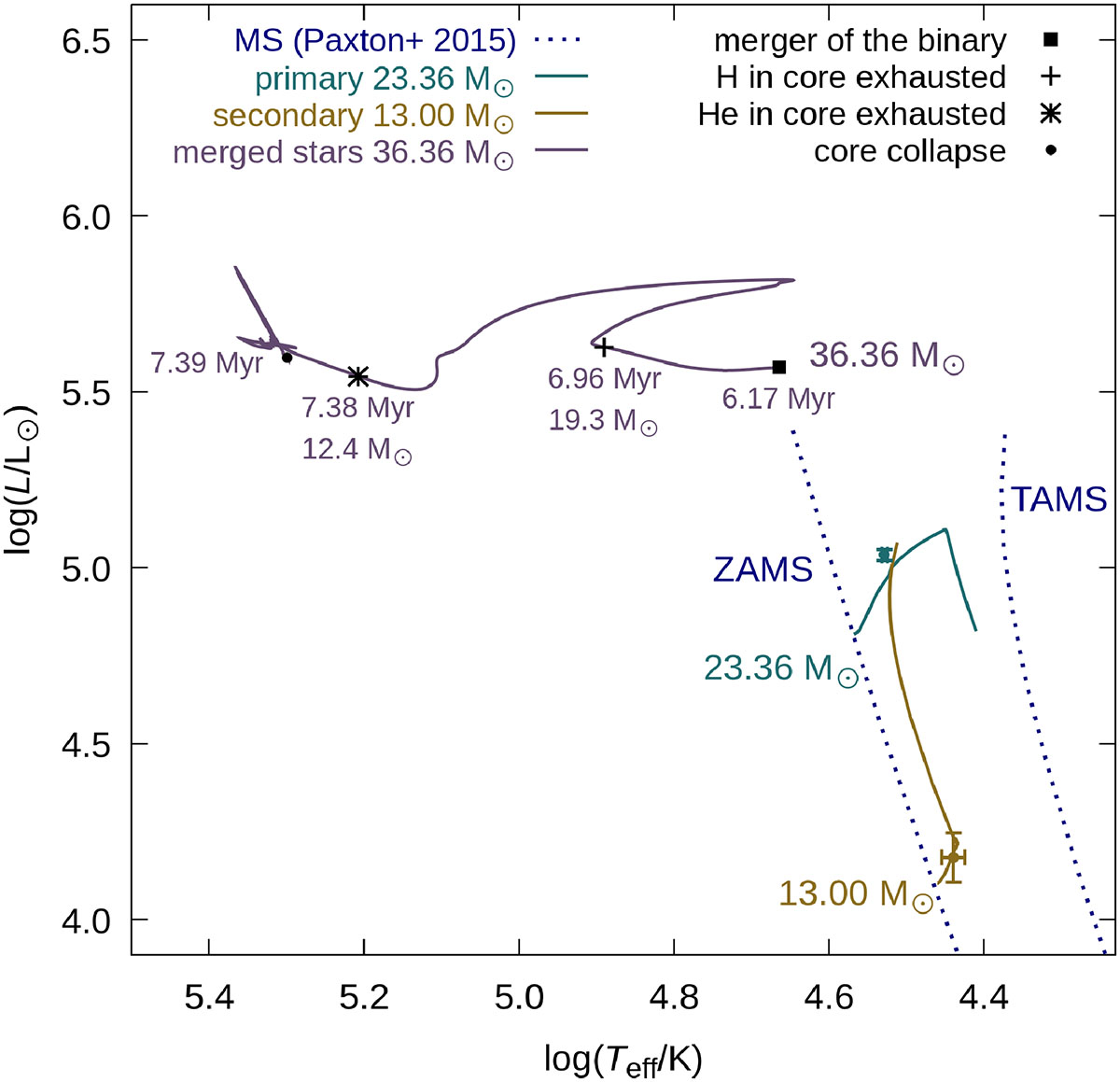
Same as Fig. 6 but with evolutionary tracks for the inner binary (primary and secondary) computed from the ZAMS until the onset of Roche lobe overflow by the accretor. Subsequently, we assumed a common-envelope phase and a merger resulting in a star with a mass of 36.36 M⊙ rotating at 85% of its critical velocity (typical velocity for mergers) and having a stellar wind with a Dutch scaling factor of 1.0. This star evolves into a hotter WR star, unlike the more slowly rotating and less massive stars in Fig. 6, which evolve into supergiants or giants. Based on the compactness parameter, the core collapse is expected to result in a black hole.
Current usage metrics show cumulative count of Article Views (full-text article views including HTML views, PDF and ePub downloads, according to the available data) and Abstracts Views on Vision4Press platform.
Data correspond to usage on the plateform after 2015. The current usage metrics is available 48-96 hours after online publication and is updated daily on week days.
Initial download of the metrics may take a while.