


Fig. 3.
Download original image
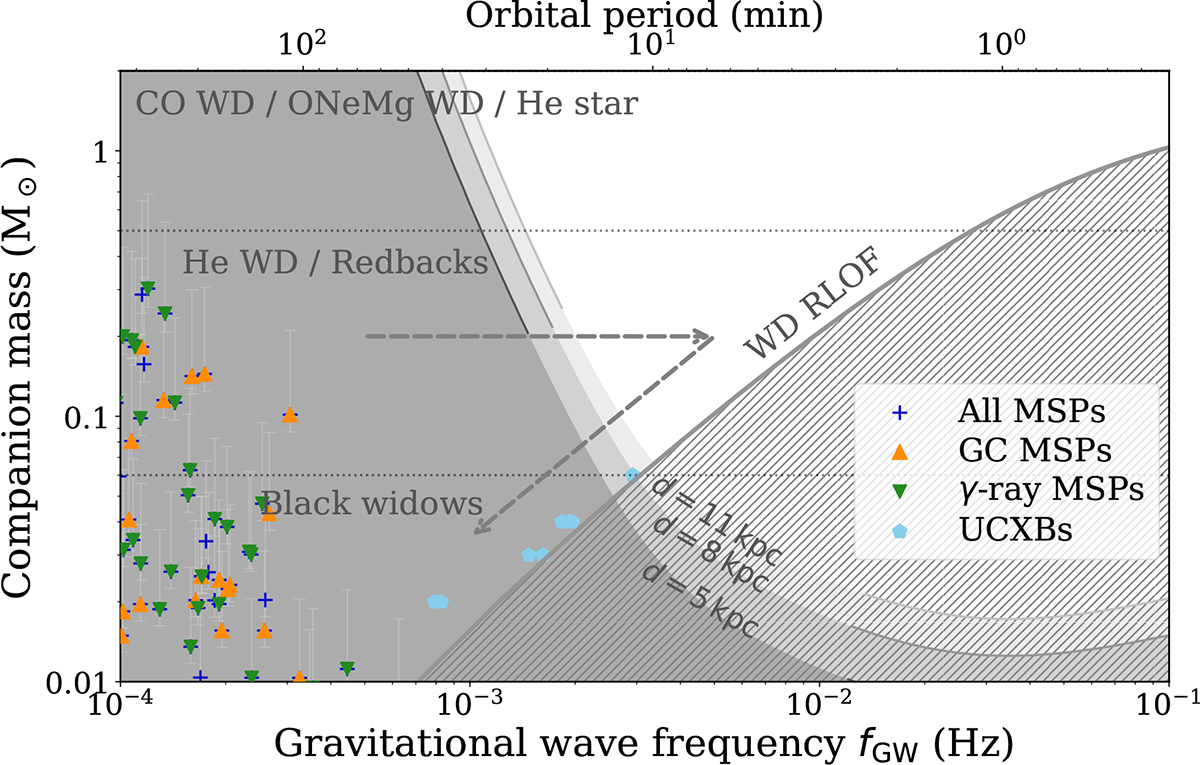
Detectability of a binary system containing a 1.4 M⊙ MSP with LISA, shown as a function of companion mass and gravitational-wave frequency (bottom x-axis) or orbital period (top x-axis). Grey contours indicate LISA’s 4-year signal-to-noise threshold (ρ4 yr = 7) for sources located at 5 (dark grey), 8 (grey), and 11 kpc (light grey). Dashed horizontal lines mark approximate boundaries between different classes of MSP binaries: black widows (low-mass companions, M ≲ 0.06 M⊙), redbacks and He WDs (intermediate-mass companions, 0.06 ≲ M ≲ 0.5 M⊙), and more massive donors such as CO/ONeMg WDs or He stars (M ≳ 0.5 M⊙). The grey solid curve marks the Roche-lobe overflow (RLOF) boundary for WD donors, indicating the onset of stable mass transfer. Observed MSP binaries are shown as coloured symbols, following the same classification as in Fig. 1. UCXBs lying near the WD RLOF line are shown as light blue pentagons. The two-segment grey arrow illustrates the expected evolutionary track of close binaries.
Current usage metrics show cumulative count of Article Views (full-text article views including HTML views, PDF and ePub downloads, according to the available data) and Abstracts Views on Vision4Press platform.
Data correspond to usage on the plateform after 2015. The current usage metrics is available 48-96 hours after online publication and is updated daily on week days.
Initial download of the metrics may take a while.