


Fig. 17.
Download original image
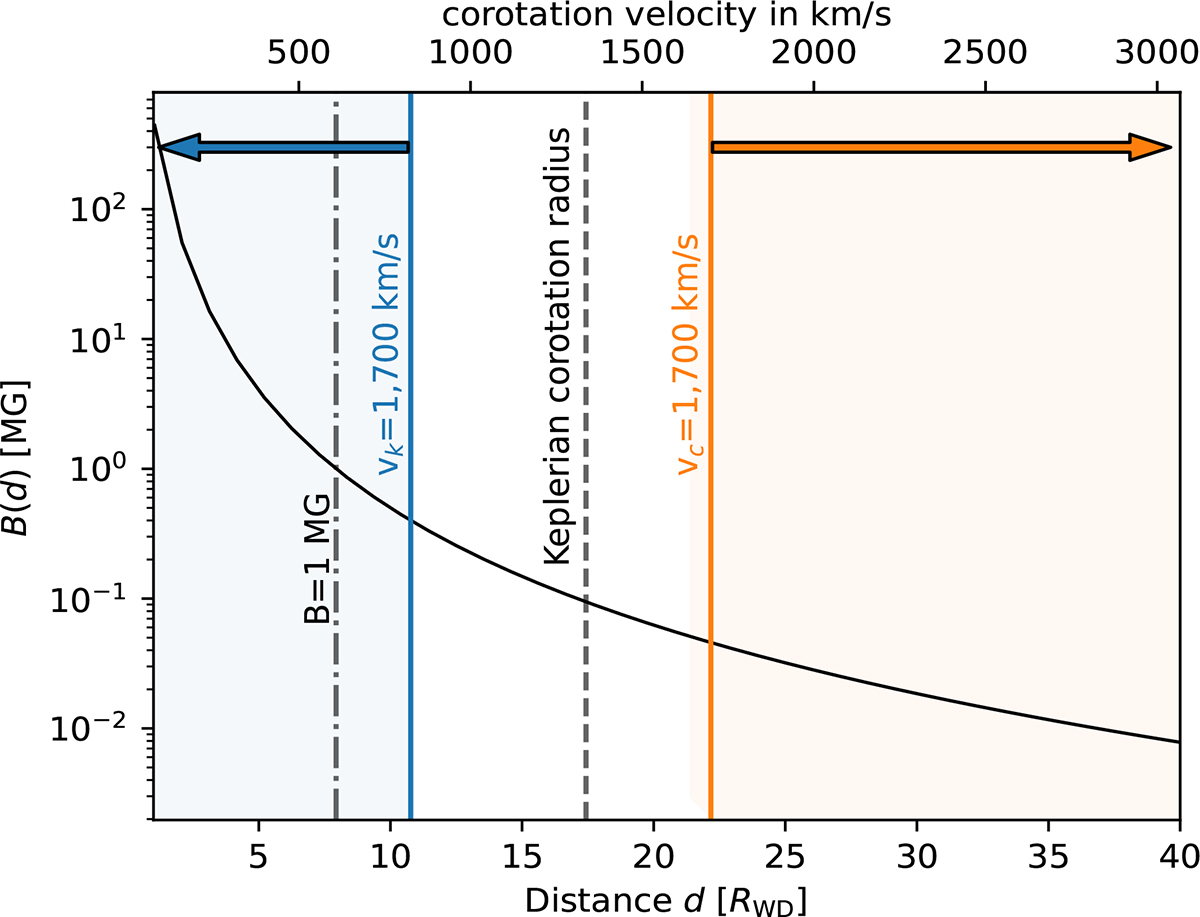
Diagram showing the possible location of the line emitting material. On the x-axis, we plot the distance from the white dwarf (d) in white dwarf radii (RWD ≈ 4800 km). The black solid line indicates the strength of the magnetic field at the distance d, assuming a field of dipole strength at surface of ≈500 MG. We highlight with a dash-dotted vertical line where the field becomes weaker than one MG. The top x-axis marks the corotation velocity corresponding to each radial coordinate. The ratio of centrifugal to gravitational accelerations is unity at the Keplerian corotation radius (vertical dashed line). The vertical blue line indicates the distance at which the Keplerian velocity equals the observed velocity in Hα; the blue shaded region shows where the emitting material would lie if it was moving in Keplerian orbit, depending on inclination (with the vertical blue line indicating the maximum distance for an inclination i = 90°). We think the material is instead corotating with the white dwarf, with the vertical orange line indicating the distance at which the corotation velocity equals the observed velocity in Hα. The orange shaded region shows where we expect the material to lie, depending on inclination (with the vertical orange line indicating the minimum distance for i = 90°).
Current usage metrics show cumulative count of Article Views (full-text article views including HTML views, PDF and ePub downloads, according to the available data) and Abstracts Views on Vision4Press platform.
Data correspond to usage on the plateform after 2015. The current usage metrics is available 48-96 hours after online publication and is updated daily on week days.
Initial download of the metrics may take a while.