


Fig. 1
Download original image
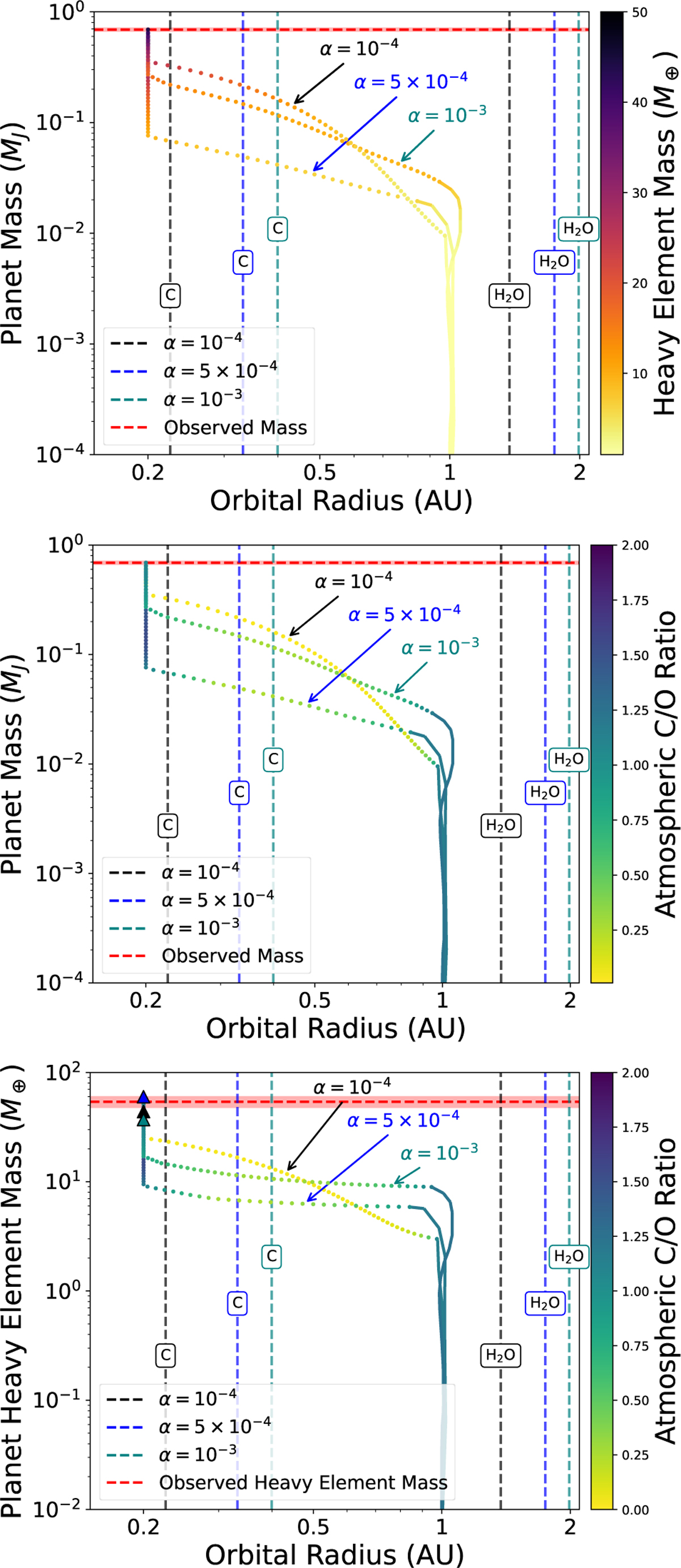
Growth tracks showing the orbital evolution of a planet simulated in the disc of WASP-84 for three different disc viscosities: α = 10−4, α = 5 × 10⁻⁴, and α = 10−3. The planet originates at an orbital radius of 1 AU and migrates inwards. Top: mass evolution of the planet, colour-coded by the planet’s heavy element mass. Middle: mass evolution of the planet, colour-coded by the planet’s atmospheric carbon-to-oxygen ratio. Bottom: heavy element mass evolution of the planet colour-coded by the planet’s atmospheric carbon-to-oxygen ratio. The locations of the C and H2O evaporation fronts are shown for the three different viscosities. The horizontal dashed red line and shaded region show the observed mass (top and middle) and the observed heavy element mass (bottom) and their uncertainties. The coloured triangles in the bottom plot show the final simulated heavy element mass for each viscosity. Growth tracks plotted as solid lines indicate that the planet is undergoing pebble accretion, and dotted lines indicate gas accretion.
Current usage metrics show cumulative count of Article Views (full-text article views including HTML views, PDF and ePub downloads, according to the available data) and Abstracts Views on Vision4Press platform.
Data correspond to usage on the plateform after 2015. The current usage metrics is available 48-96 hours after online publication and is updated daily on week days.
Initial download of the metrics may take a while.