


Fig. 10
Download original image
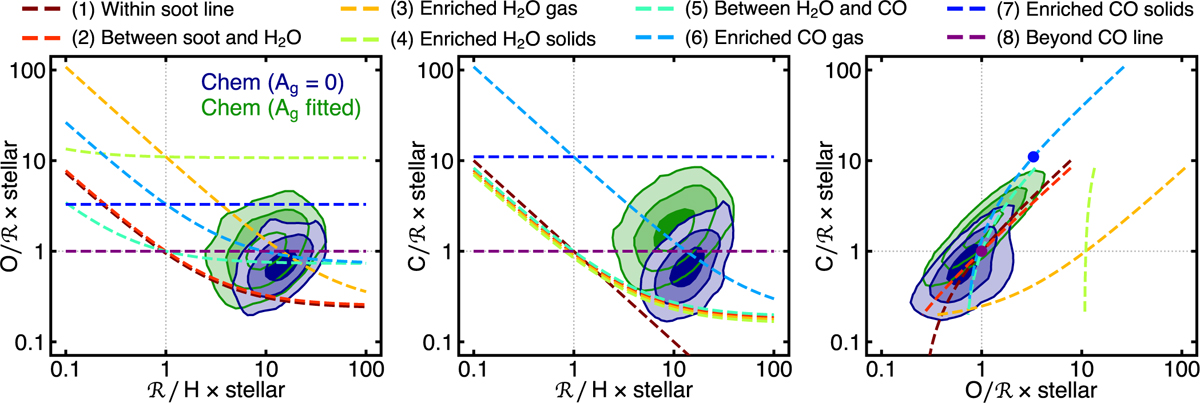
Measured atmospheric composition of WASP-121b from the chemical equilibrium retrievals (blue and green 1, 2, and 3σ contours) compared to predictions from the disc formation model of Chachan et al. (2023). Here, each dashed coloured line (or solid point in the case of a projection) corresponds to an envelope composition that WASP-121b would have accreted for different theoretical protoplanetary disc formation locations relative to the soot, H2O, and CO snowline. Scenario 1 corresponds to the inner disc where all carbon is in the gas phase. Scenario 2 is between the soot and H2O snowlines where carbon can be held in solids. Scenarios 3 and 4 are slightly within and exterior to the H2O snowline where the gas and solid phases can, respectively, be enriched in H2O. Scenario 5 is between the H2O and CO snowlines where H2O will be in ice form but CO remains in gas form. Scenarios 6 and 7 are inward and outward of the CO snowline where gas and solids are CO enriched. Scenario 8 is outwards of the CO snowline where even CO is condensed and accreted via solids. All abundance ratios are relative to the stellar values (dotted grey lines). While the scenarios most consistent with the measured atmospheric composition of WASP-121b (i.e. passing through the contours in all three panels) are formation in a CO-rich gas environment (scenario 6, light blue dashed line) or beyond the CO snowline (scenario 8, purple dashed line), most other scenarios from this model remain consistent at 3σ.
Current usage metrics show cumulative count of Article Views (full-text article views including HTML views, PDF and ePub downloads, according to the available data) and Abstracts Views on Vision4Press platform.
Data correspond to usage on the plateform after 2015. The current usage metrics is available 48-96 hours after online publication and is updated daily on week days.
Initial download of the metrics may take a while.