


Fig. 6
Download original image
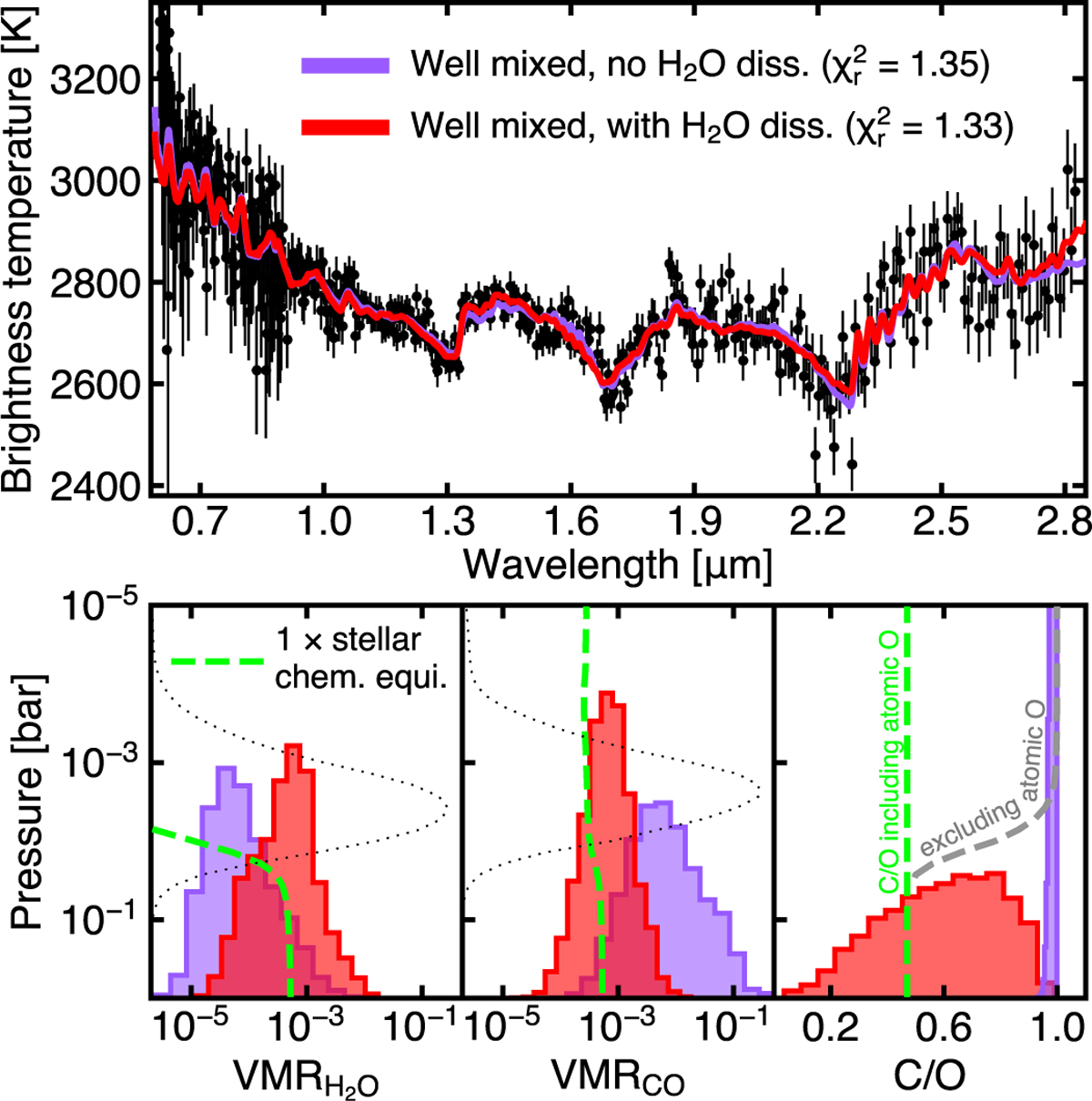
Importance of accounting for thermal dissociation in atmospheric composition inferences of ultra-hot Jupiters. Top: brightness temperature NIRISS spectrum (black points) overplotted with the best fit model from free retrieval analyses without (purple) and with (red) thermal dissociation parameterised. Bottom: inferred atmospheric compositions for H2O (left), CO (middle), and the derived C/O ratio from counting atoms in all C- and O-bearing molecules included in the retrieval (right) compared to abundance profiles for a fiducial WASP-121b chemical equilibrium model assuming a stellar-like composition (dashed lime green lines). While CO is relatively constant with altitude, H2O molecules are expected to be significantly thermally dissociated at pressures probed (dotted black lines). While the true atmospheric C/O ratio is constant at all pressures (dashed lime green line), the C/O derived from molecules only (dashed grey line) is not owing to the majority of oxygen atoms being in atomic form at lower pressures. As a result, the observed C/O ratio from only considering molecules will be biased to higher values (near unity) due to not accounting for atomic oxygen, which these observations are not sensitive to. Accounting for dissociation does lead to less precise but likely more accurate abundance measurements as it fits for the H2O abundance of the deep atmosphere. Although the spectrum can still be well fitted when neglecting H2O dissociation, the retrieved abundances and C/O ratio may not reflect the true bulk atmospheric composition.
Current usage metrics show cumulative count of Article Views (full-text article views including HTML views, PDF and ePub downloads, according to the available data) and Abstracts Views on Vision4Press platform.
Data correspond to usage on the plateform after 2015. The current usage metrics is available 48-96 hours after online publication and is updated daily on week days.
Initial download of the metrics may take a while.