


Fig. 8
Download original image
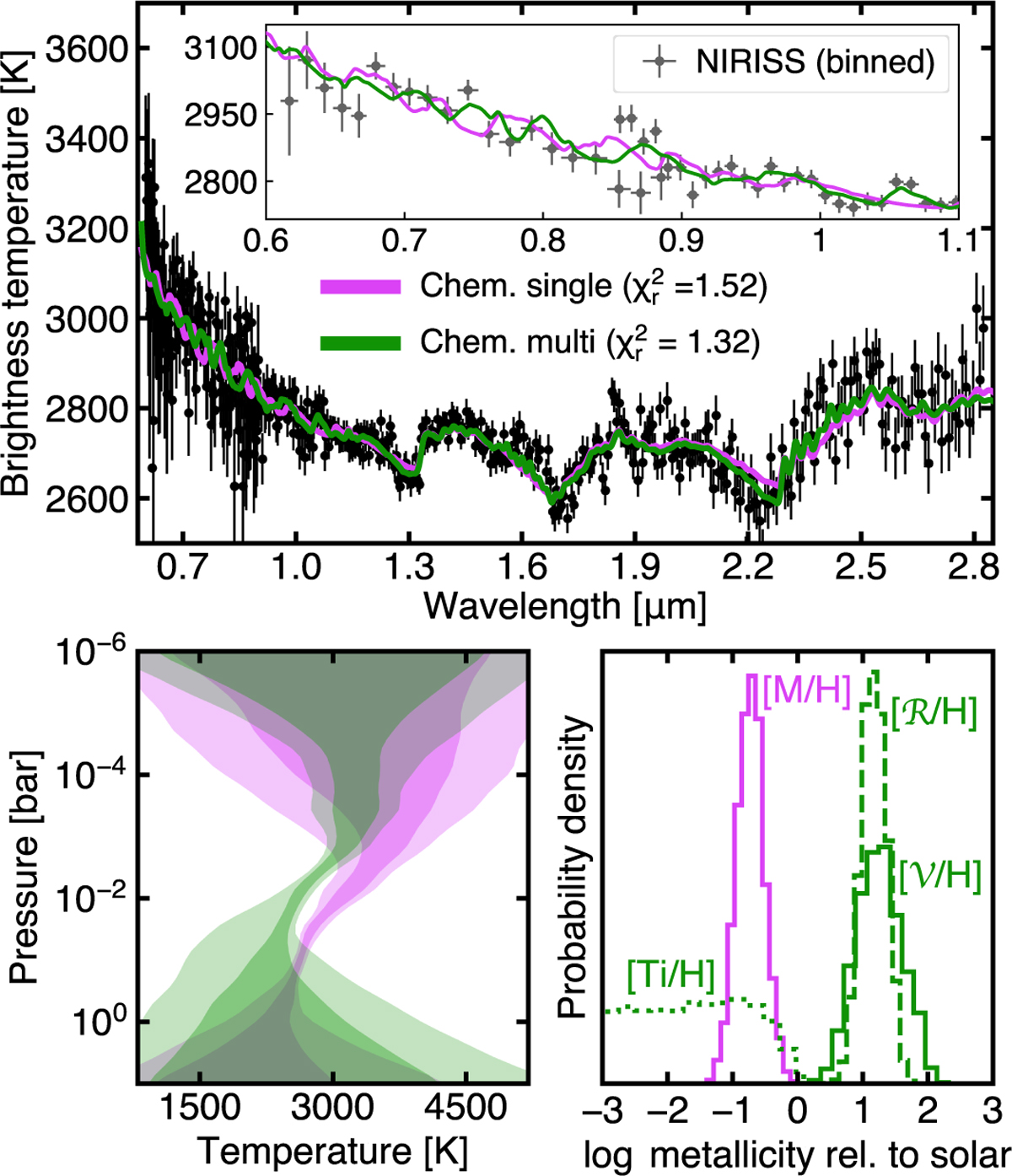
Importance of fitting more than a single global atmospheric metallicity in chemical equilibrium retrievals when probing spectral features affected by disequilibrium processes such as cold-trapping. Top: brightness temperature NIRISS spectrum (black points) overplot-ted with the best fit model from chemical equilibrium retrieval analyses only fitting for a single overall metallicity (pink), or fitting for volatiles, refractories, and titanium separately (green). The inset panel shows a zoom in on the 0.6–1.1 µm region, with the data now binned to R = 100 for order 1 and R = 50 for order 2 (grey points) for better visualisation. Bottom left: retrieved TP profile in both cases (with Ag fitted) showing that the single-metallicity case prefers an inversion much deeper in the atmosphere. Bottom right: recovered abundances highlighting the importance of treating titanium as a separate parameter relative to other species in chemical equilibrium retrievals. Even when allowed to vary independently within a retrieval (‘Chem. multi’, green), the volatile ([𝒱/H], solid) and refractory ([ℛ/H], dashed) metallicities are recovered at similar enriched values while [Ti/H] (dotted) is significantly depleted in comparison. Enforcing all species to vary according to a single global metallicity (‘Chem. single’, [M/H], pink) and only allowing the C/O ratio to vary can result in some biased average of the depleted [Ti/H] and super-solar other metals to be inferred.
Current usage metrics show cumulative count of Article Views (full-text article views including HTML views, PDF and ePub downloads, according to the available data) and Abstracts Views on Vision4Press platform.
Data correspond to usage on the plateform after 2015. The current usage metrics is available 48-96 hours after online publication and is updated daily on week days.
Initial download of the metrics may take a while.