


Fig. 1.
Download original image
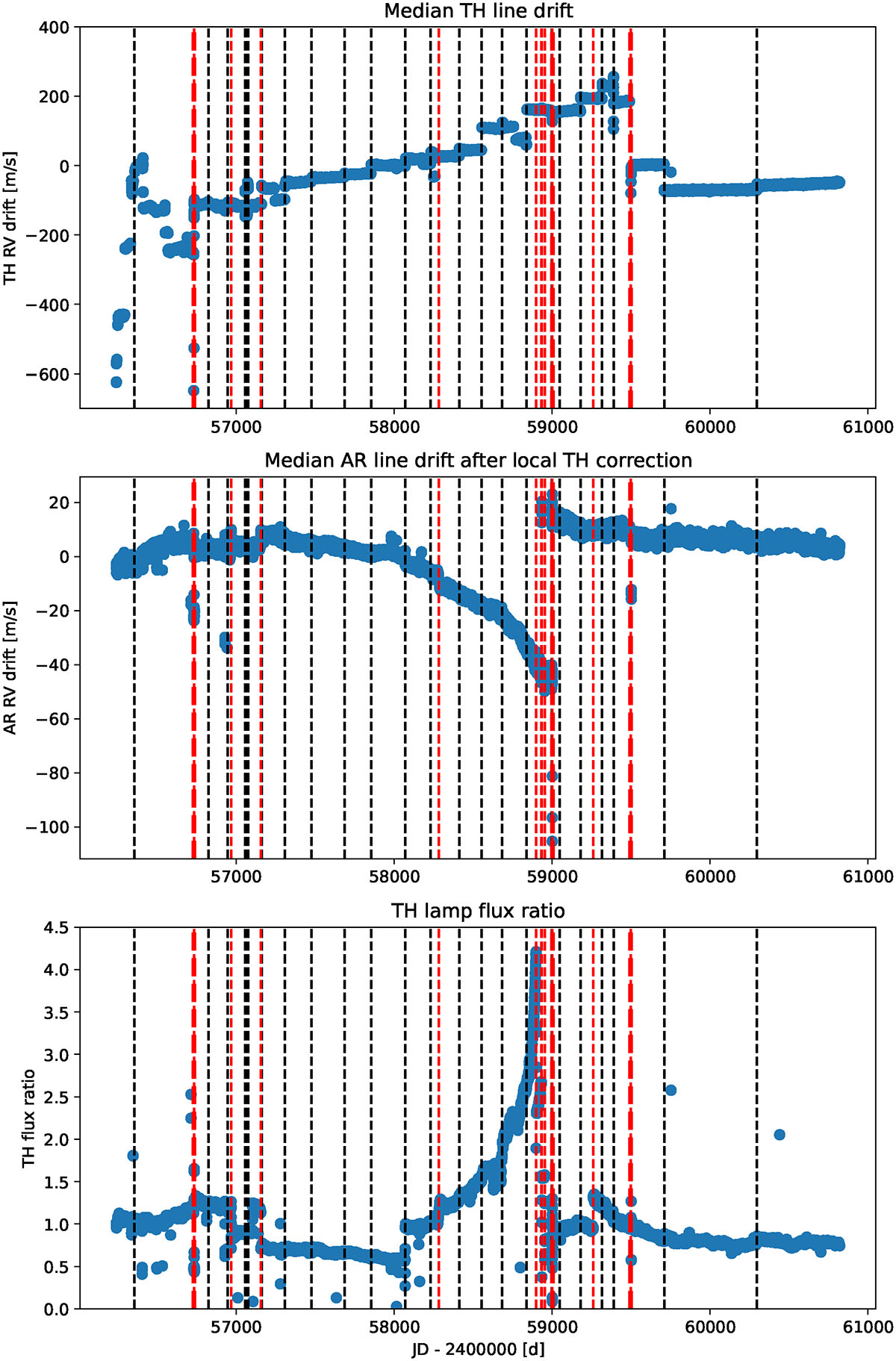
Top: Median drift of all TH lines as a function of time. This tracks the drift of HARPS-N over time, which stays below one km s−1 despite several drastic instrumental interventions. Middle: Median behaviour of the AR lines as a function of time once the drift of TH lines has been corrected for. This correction is applied locally on different regions of the detector to be less sensitive to LSF variations (see text). Bottom: Integrated flux of the TH lamp with respect to a reference as a function of time. We observed that between JD = 2458500 and 2459002 (16 January 2019 to 2 June 2020), the TH flux ratio reached very high values, which will have an impact on wavelength solution derivation. The thick dashed vertical red lines correspond, chronologically, to the change of the HARPS-N focus, the change of the TH-AR HC lamp used for wavelength solution, and the change of the detector cryostat. The thin dashed vertical red lines correspond to sudden changes in the flux of the TH-AR HC lamp (see bottom panel), and the dashed vertical black lines correspond to detector warm-ups. More details about those events are given in Table A.
Current usage metrics show cumulative count of Article Views (full-text article views including HTML views, PDF and ePub downloads, according to the available data) and Abstracts Views on Vision4Press platform.
Data correspond to usage on the plateform after 2015. The current usage metrics is available 48-96 hours after online publication and is updated daily on week days.
Initial download of the metrics may take a while.