


Fig. 5
Download original image
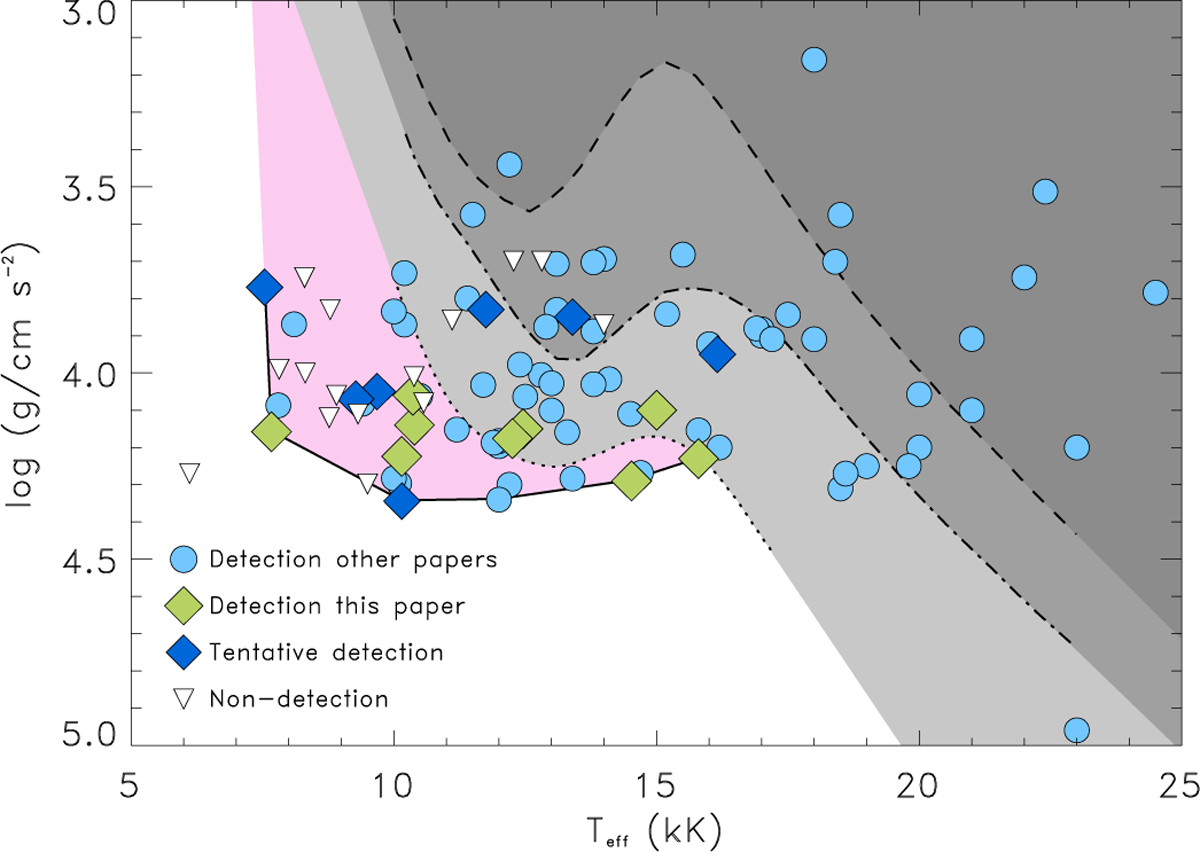
Diagram log g–Teff. Dashed and dot-dashed black lines are taken from Babel (1996), the dotted line is taken from Hunger & Groote (1999). These lines locate the zone where stellar winds are theoretically expected. Dark gray zone: homogeneous wind; gray zone: multicomponent wind; light gray zone: multicomponent wind with a lower fraction of hydrogen coupled to metals. These zones are obtained by extrapolating the original curves to encompass a range of parameters large enough to include all the BA-type magnetic stars reported in this paper, as well as other stars already discovered to be radio-loud. The pink zone, delimited by the black solid line (and its extrapolations), identifies a region on the log g–Teff parameter’s space that is outside the wind zones but where several radio-loud stars still fall. The fact that there are detected stars outside the wind zone perhaps means that the wind zones do not have robust boundaries. On the other hand, the presence of undetected stars in the wind regions requires additional highly sensitive radio observations to see whether these stars are indeed radio quiet or have only very faint radio emissions.
Current usage metrics show cumulative count of Article Views (full-text article views including HTML views, PDF and ePub downloads, according to the available data) and Abstracts Views on Vision4Press platform.
Data correspond to usage on the plateform after 2015. The current usage metrics is available 48-96 hours after online publication and is updated daily on week days.
Initial download of the metrics may take a while.