


Fig. A.2.
Download original image
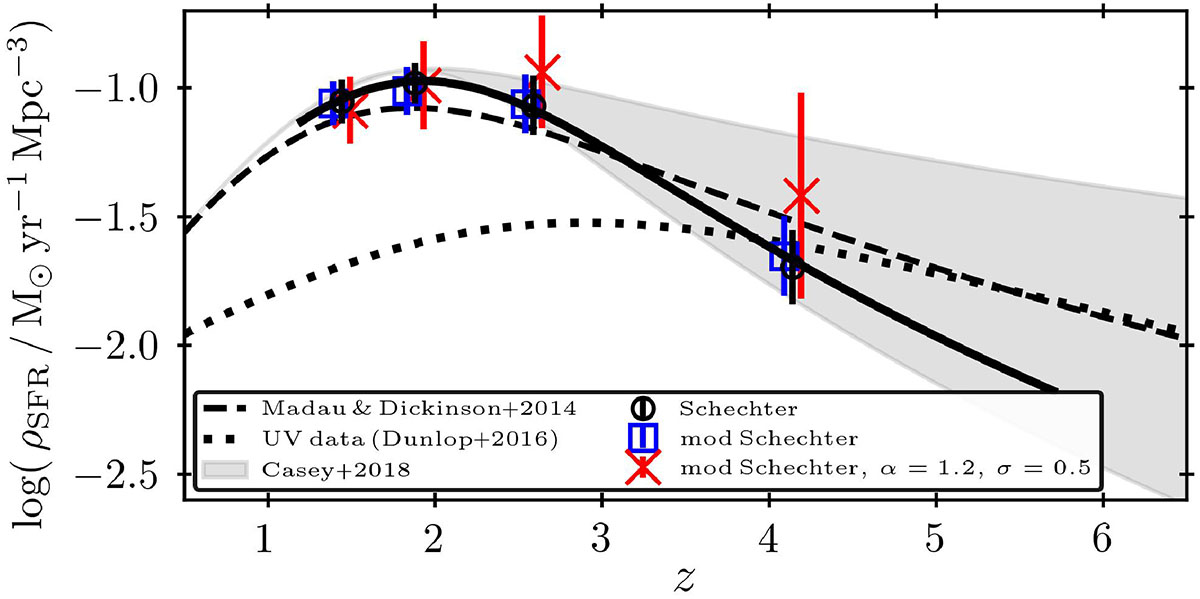
Star formation rate density found by integrating the best-fit curves of Figure A.1 between 8.0 < LIR/L⊙ < 14.0. Similarly to Figure 7, the black solid line represents the IR ρSFR evolution found in Madau & Dickinson (2014), while the blue dotted line shown the evolution of the UV ρSFR of Dunlop (2016). The shaded region shows the results of Casey et al. (2018), bounded at the bottom by the dust-poor models and at the top by the dust-rich models of the early Universe. The black circles with the solid curve represent this work’s results found in Section 3.2. Values of ρSFR corresponding to the modified Schechter fits (Eqaution A.1) with the best-fit α and σ parameters of −0.26 and 0.31, respectively, are shown with blue squares. Data found from modified Schechter fits with α and σ fixed at recent literature z ≪ 1 values of −0.2 and 0.5, respectively, are depicted with red crosses. It can be seen that, while using the modified Schechter function with all the parameters allowed to vary freely produces results almost identical to the classical Schechter results of this work, setting α and σ at the z ≪ 1 best-fit values if Gruppioni et al. (2013), produces significantly larger numbers at highest redshift bins.
Current usage metrics show cumulative count of Article Views (full-text article views including HTML views, PDF and ePub downloads, according to the available data) and Abstracts Views on Vision4Press platform.
Data correspond to usage on the plateform after 2015. The current usage metrics is available 48-96 hours after online publication and is updated daily on week days.
Initial download of the metrics may take a while.