


Fig. A.2
Download original image
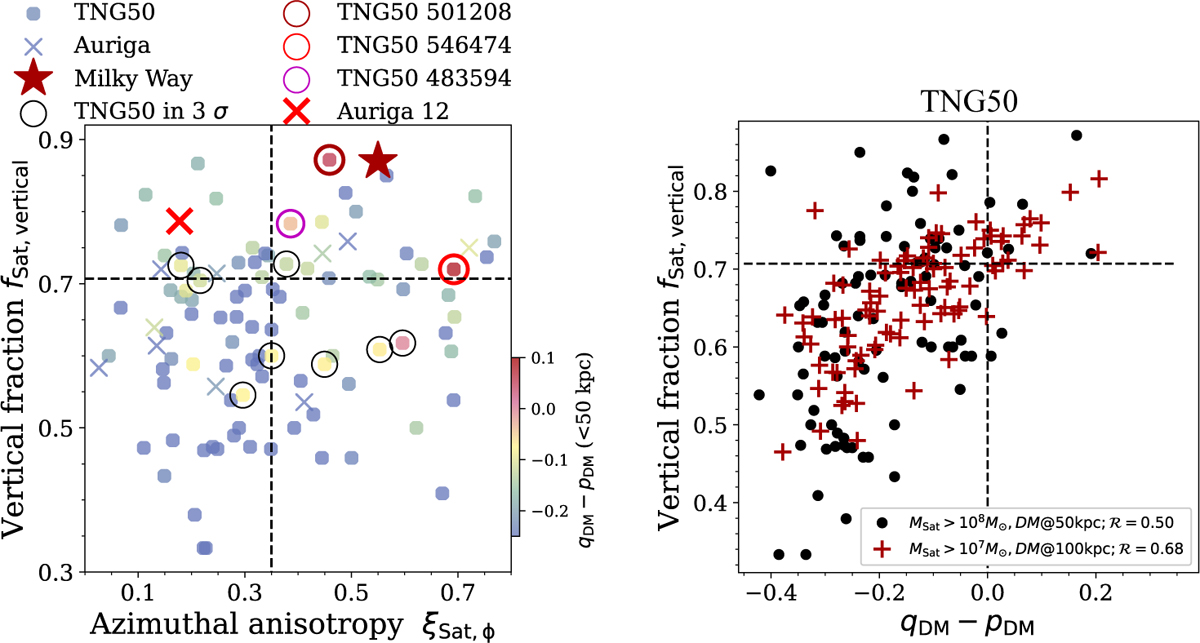
Arrangement of satellite system in the Milky Way and the Milky Way-like simulated galaxies, and relation with the 3D shape of DM halo. Left: the configuration of satellite system of each galaxy is characterised by two parameters: the fraction of satellites moving on vertical orbits fSats,verticai, and the azimuthal anisotropy of the satellite distribution ξSat,φ. Each dot is one galaxy coloured by their DM halo shape qDM - pDM (< 50 kpc). The red star represents the Milky Way. The 13 TNG50/Auriga galaxies having DM halo shapes within 3σ confidence level of the Milky Way are highlighted. Right: correlation of the DM halo shape qDM - pDM versus satellite distribution fSats,vertical of the 94 TNG50 galaxies, R in the legend is the Pearson correlation coefficiant. The correlation becomes stronger when increasing the number of satellites by taking a lower mass threshold and measuring DM shape at a larger radius.
Current usage metrics show cumulative count of Article Views (full-text article views including HTML views, PDF and ePub downloads, according to the available data) and Abstracts Views on Vision4Press platform.
Data correspond to usage on the plateform after 2015. The current usage metrics is available 48-96 hours after online publication and is updated daily on week days.
Initial download of the metrics may take a while.