


Fig. 9
Download original image
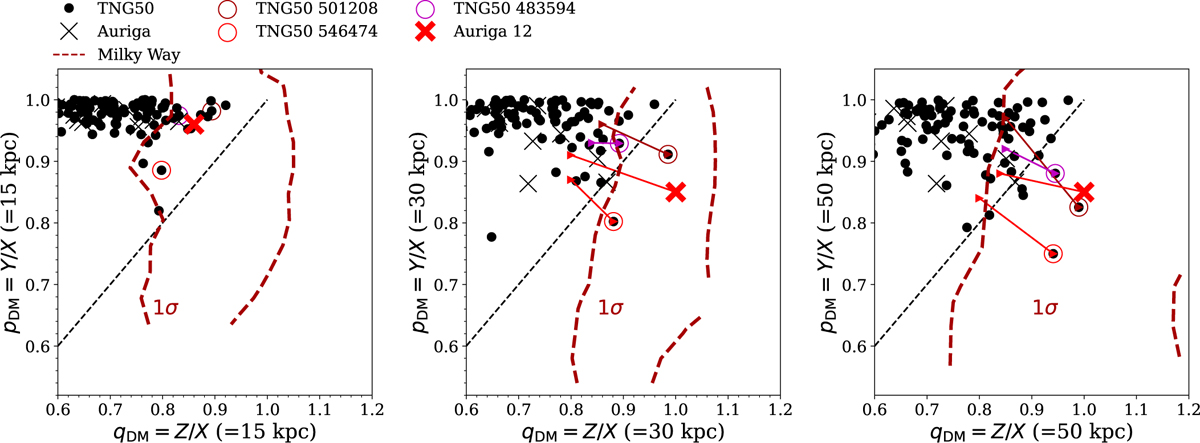
DM axis ratio measured at three different radii, r = 15,30,50 kpc, for TNG50 and Auriga galaxies, in comparison with that of the Milky Way obtained by our model allowing pDM(r) and qDM(r) vary as a function of radius. This model has a large uncertainty and we only weakly constrain the DM axis ratios at different radii, which shows a trend to be more oblate in the inner regions and to be more vertically aligned in the outer regions, consistent with the trend shown in the Milky Way analogues, TNG50 501208, TNG50 546474, Auriga 12, and TNG50 483294. For these four galaxies, the arrows point to their intrinsic axis ratios measured at the principle axes of the DM halo. These four galaxies have twisted DM halos and are vertically aligned at r > 20 kpc, as we obtained for the Milky Way, bur their intrinsic DM shapes are common compared to the general TNG50/Auriga galaxies if we hypothetically tilt their disc and inner DM halo to the long-intermediate axes plane of the outer DM halo.
Current usage metrics show cumulative count of Article Views (full-text article views including HTML views, PDF and ePub downloads, according to the available data) and Abstracts Views on Vision4Press platform.
Data correspond to usage on the plateform after 2015. The current usage metrics is available 48-96 hours after online publication and is updated daily on week days.
Initial download of the metrics may take a while.