


Fig. 1
Download original image
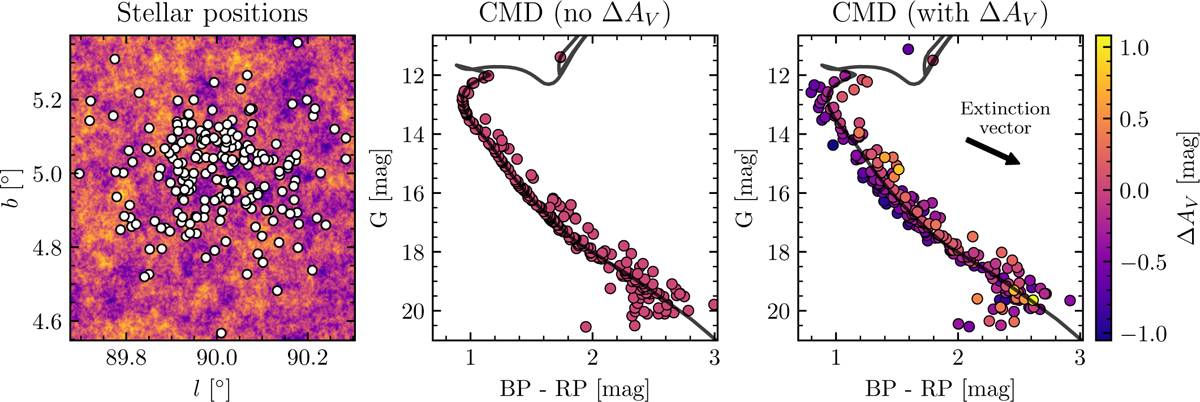
Example of simulated cluster with photometry broadened by differential reddening. The cluster has an age of 1 Gyr, a mass of 500 M⊙, an extinction (AV) of 1.5 mag, and 0.3 mag of differential reddening (measured in colour: E(B − V)); it is at a distance of 1 kpc. Left: random fractal noise map used to pick a differential reddening for each star. Member stars are shown as white circles, with the coloured background corresponding to changes in extinction, AV. Centre: Simulated CMD for cluster without differential reddening, but including the impact of unresolved binary stars and Gaia photometric errors. The black line shows the isochrone that the cluster’s member stars were originally drawn from. Right: final simulated CMD including impact of differential reddening. Member stars are colour-coded based on their differential reddening with the same colour scheme as the left panel. The labelled black arrow shows the mean extinction vector for stars in this cluster. For this cluster, differential reddening is strong enough to smooth out the clean sequence of unresolved binaries: main sequence stars with higher reddening move toward the binary sequence, and vice versa for binaries with lower reddening.
Current usage metrics show cumulative count of Article Views (full-text article views including HTML views, PDF and ePub downloads, according to the available data) and Abstracts Views on Vision4Press platform.
Data correspond to usage on the plateform after 2015. The current usage metrics is available 48-96 hours after online publication and is updated daily on week days.
Initial download of the metrics may take a while.