


Fig. 4
Download original image
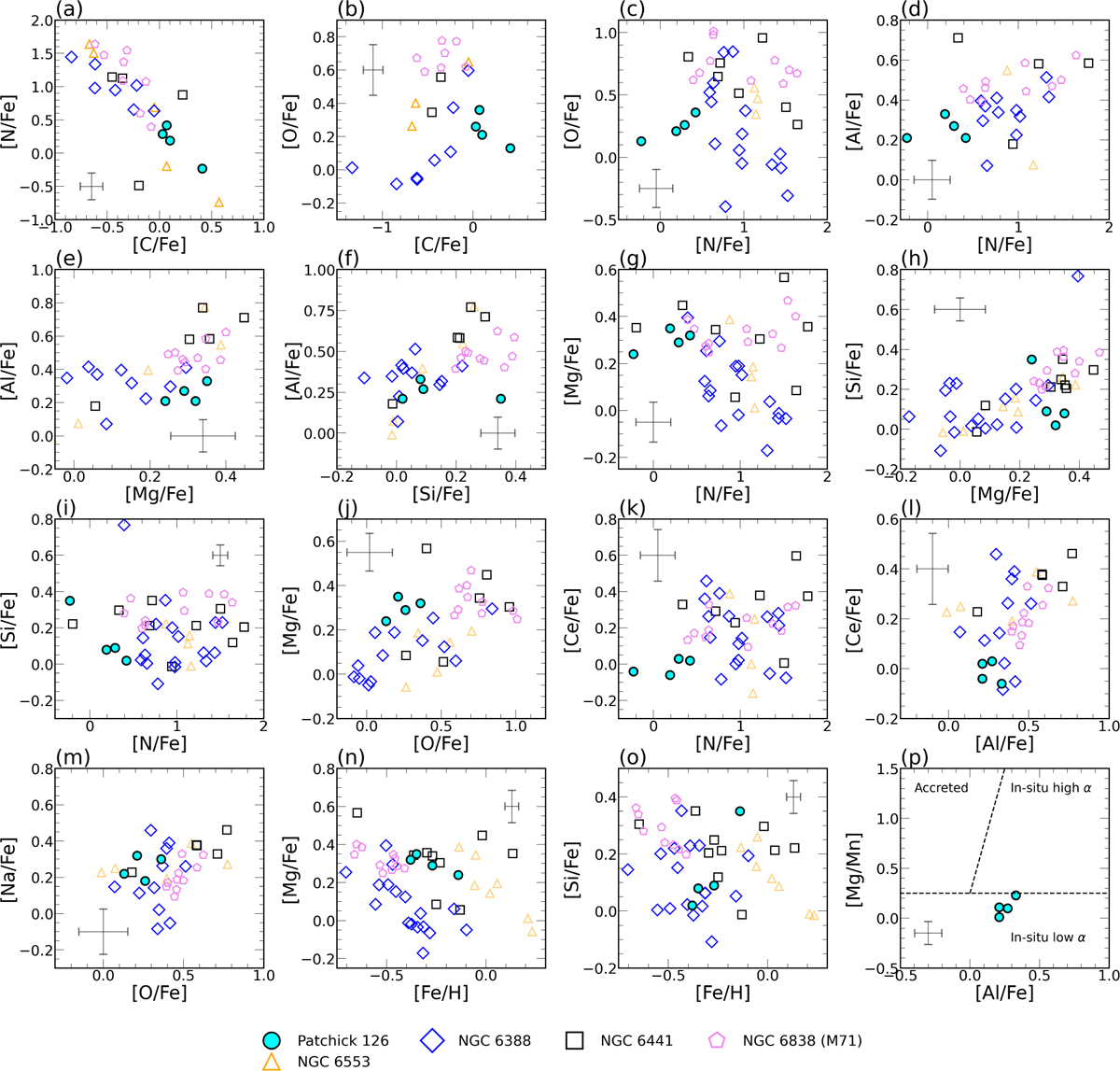
Combined α-, light-, odd-Z, and s-process elements from our BACCHUS results listed in Table 4. Notably, we used mean values for common elements in the H and K band. Panels a–p: [C/Fe]–[N/Fe], [C/Fe]–[O/Fe], [N/Fe]–[O/Fe], [C/Fe]–[N/Al], [Mg/Fe]–[Al/Fe], [Si/Fe]–[Al/Fe], [N/Fe]–[Mg/Fe], [Mg/Fe]–[Si/Fe], [N/Fe]–[Si/Fe], [O/Fe]–[Mg/Fe], [N/Fe]–[Ce/Fe], [Al/Fe]–[Ce/Fe], [O/Fe]–[Na/Fe], [Fe/H]–[Mg/Fe], [Fe/H]– [Si/Fe], and [Al/Fe]–[Mg/Mn] distributions for Patchick 126 (cyan circles). We compare our results with other APOGEE-2 GCs examined by Mészáros et al. (2020): NGC 6388 (open blue diamonds), NGC 6441 (open black squares), NGC 6838 (M71; open violet pentagons), and NGC 6553 (open orange triangles). The error bars mark the typical uncertainty (σtot) listed in Table 4. The dashed black lines in Panel p define the criterion to separate in situ from accreted populations, similar to that defined by Horta et al. (2021), Fernández-Trincado et al. (2022a), Souza et al. (2023).
Current usage metrics show cumulative count of Article Views (full-text article views including HTML views, PDF and ePub downloads, according to the available data) and Abstracts Views on Vision4Press platform.
Data correspond to usage on the plateform after 2015. The current usage metrics is available 48-96 hours after online publication and is updated daily on week days.
Initial download of the metrics may take a while.