


Fig. 1.
Download original image
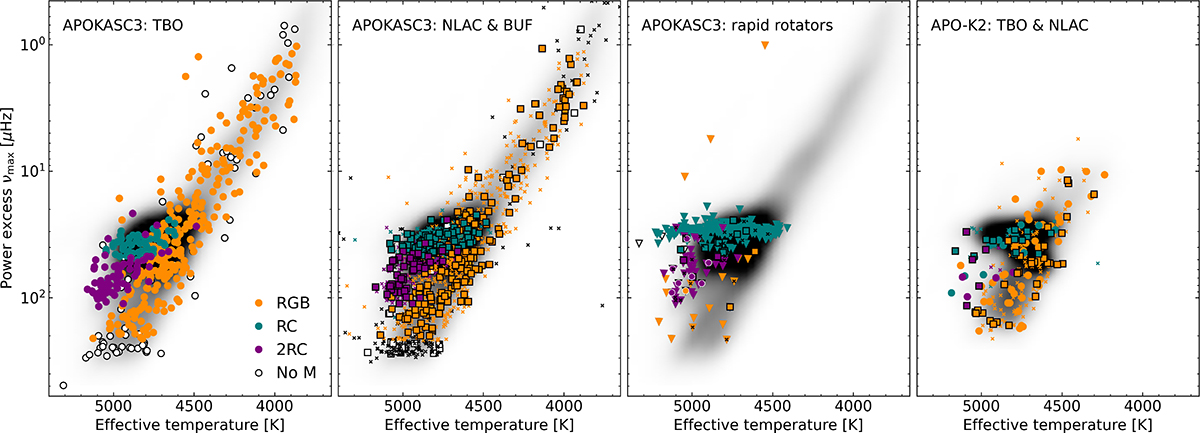
Seismic Hertzsprung-Russell diagrams of the investigated catalogs and binary samples. The two panels from left to right depict the targets in the APOKASC 3 catalog, with solutions in the Gaia catalogs of Two-Body Orbits (TBOs) as dots and nonlinear or acceleration solutions (NLACs) from NSS as squares. Additionally, the second panel shows the Binary Union Flag (x), which RUWE dominates. The third panel shows the stars with rapid surface rotation (v sin i ≥ 5 km/s) as triangles. Rapidly rotating targets found in binary systems are depicted as dots and squares or marked with crosses, depending on their solution type. The right panel presents TBO, NLAC, and RUWE binary indicators for targets in the APO-K2 catalog. The marker’s surface color indicates its seismically determined evolutionary state, as indicated by the legend in the left panel; RGB: red-giant branch, RC: red clump, 2RC: secondary clump, No EvSt: no evolutionary state determined but mass reported, “No M” indicates lower-quality data that did not allow for a seismically inferred stellar mass. Stars with NLAC solutions are further marked with black edges.
Current usage metrics show cumulative count of Article Views (full-text article views including HTML views, PDF and ePub downloads, according to the available data) and Abstracts Views on Vision4Press platform.
Data correspond to usage on the plateform after 2015. The current usage metrics is available 48-96 hours after online publication and is updated daily on week days.
Initial download of the metrics may take a while.