


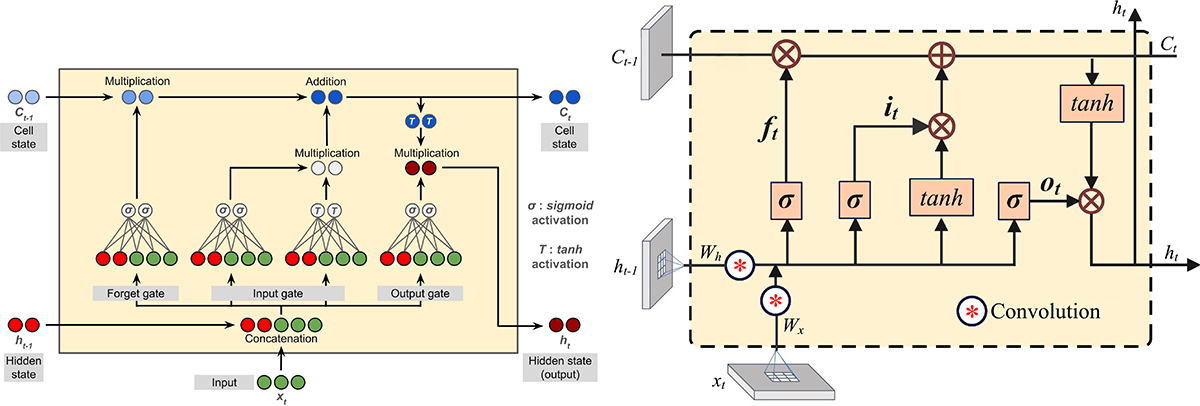
Fig. C.1.
Download original image
The left panel demonstrates how a two-unit LSTM layer processes a sequence with three features at each time step. For better visual illustration, we represent the sum of two matrix multiplications, in Equations (C.1)–(C.4), as a single matrix multiplication between a concatenated weight matrix of shape (2, 5) and a stacked vector of xt and ht − 1 of shape (5, 1), as described in Equation (C.7). The output ht has a length of 2. The right panel, adapted from Naz et al. (2024), illustrates the generalization to ConvLSTM2D, where matrix multiplication (similar to fully connected operations) is replaced by convolution operations (denoted by *), while handling both the short-term memory and input data, all of which are 2D at each time step. While the gating mechanism remains the same between an LSTM and a ConvLSTM cell, the two panels depict them differently to enhance clarity.
Current usage metrics show cumulative count of Article Views (full-text article views including HTML views, PDF and ePub downloads, according to the available data) and Abstracts Views on Vision4Press platform.
Data correspond to usage on the plateform after 2015. The current usage metrics is available 48-96 hours after online publication and is updated daily on week days.
Initial download of the metrics may take a while.