


Fig. 5.
Download original image
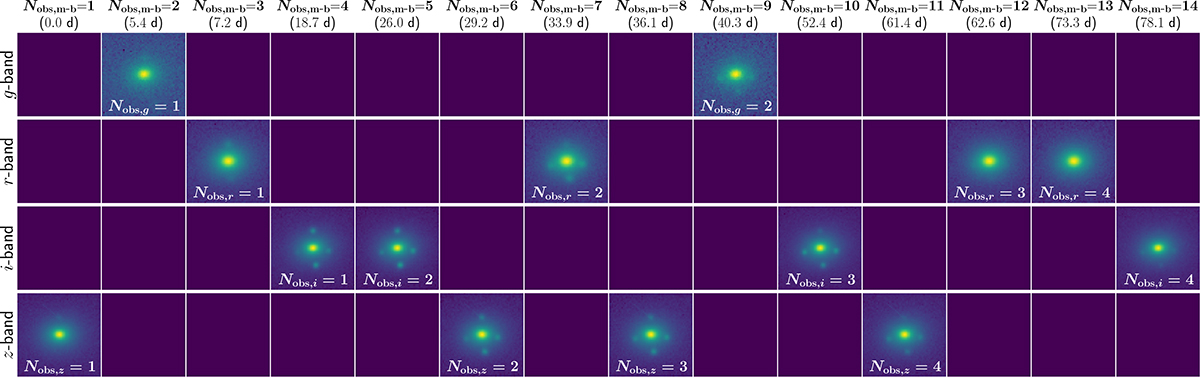
Example multiband time series of a quadruply LSN Ia, the same system whose i-band time series is shown in the top-left panel of Figure 3. At each observation epoch (Nobs,m-b), data are available in only one band; missing-band frames are zero-padded to maintain a uniform input format. The timestamps corresponding to each Nobs,m-b is shown above the top frames in parentheses (in days, relative to the first detection, which is always set to zero). The band-specific cumulative observation count (Nobs, X, where X ∈ g, r, i, z) is also marked within each observed frame. In the multiband analysis, the full time series is input as a 4-channel sequence to the multiband model, while in the single-band case, the observation sequence in the respective band is provided to the corresponding single-band model without the need of any padding. Note that we follow the HSC Transient Survey cadence here, and the multiband time series for other classes (HSC variables, SNe in galaxies) have statistically similar time sampling.
Current usage metrics show cumulative count of Article Views (full-text article views including HTML views, PDF and ePub downloads, according to the available data) and Abstracts Views on Vision4Press platform.
Data correspond to usage on the plateform after 2015. The current usage metrics is available 48-96 hours after online publication and is updated daily on week days.
Initial download of the metrics may take a while.